
Classic Bacon Carbonara Pasta With Turkey Bacon: A Lighter Take on a Beloved Dish
This Classic Carbonara delivers all the rich flavor of the original, expertly substituting traditional pork bacon with leaner turkey bacon.
This streamlined recipe comes together in under 30 minutes with just 8 core ingredients.
Serve this pasta for a quick weeknight dinner or an impressive yet easy weekend meal.
The carefully rendered turkey bacon provides a savory, smoky depth, mirroring traditional pancetta or guanciale while offering a lighter alternative without compromising the dish’s integrity. A velvety sauce, crafted from egg yolks, grated Pecorino Romano cheese, and freshly ground black pepper, coats al dente spaghetti to create that signature creamy texture and robust flavor profile. This method ensures an authentic Carbonara experience that is both simple to prepare and deeply satisfying, proving a lighter choice can still yield incredible results for any home cook.
Classic Bacon Carbonara Pasta With Turkey Bacon
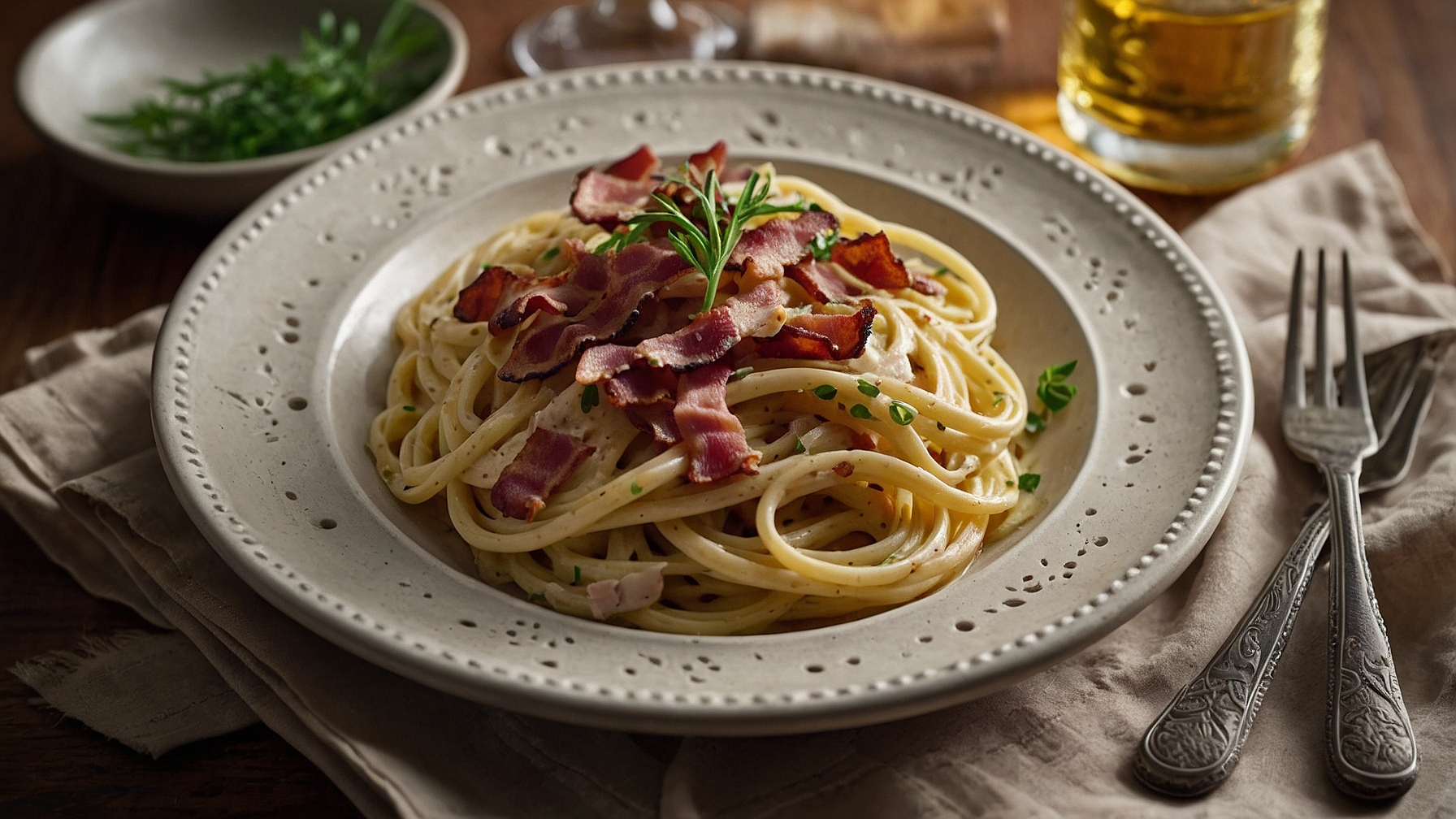
Classic carbonara with turkey bacon features creamy pasta and crisp turkey bacon.
Ingredients
- 1 lb (450g) spaghetti or bucatini
- 2 tsp (10g) kosher salt, for pasta water
- 8 oz (225g) turkey bacon, cut into 1/4-inch (0.6 cm) lardons
- 2 large whole eggs, at room temperature
- 2 large egg yolks, separated from whites, at room temperature
- 1 cup (100g) Pecorino Romano cheese, freshly grated, plus extra for serving
- 1/2 cup (50g) Parmesan cheese, freshly grated (optional)
- 1/2 tsp (2.5ml) freshly ground black pepper
- 1 tbsp (15ml) olive oil, if turkey bacon renders insufficient fat
- Fresh parsley, finely chopped, for garnish (optional)
Instructions
- Whisk 2 large whole eggs and 2 large egg yolks in a medium bowl for 30 seconds until uniform in color. Stir in 1 cup (100g) freshly grated Pecorino Romano cheese and 1/2 tsp (2.5ml) freshly ground black pepper. Set aside. Mixture must be smooth with no visible streaks.
- Heat a large, heavy-bottomed skillet over medium heat for 2 minutes. Add 8 oz (225g) turkey bacon lardons. Cook for 8-10 minutes, stirring occasionally, until deeply golden brown and crisp. Bacon must be visibly crunchy.
- Transfer crispy turkey bacon to a paper towel-lined plate using a slotted spoon. Reserve 1-2 tablespoons (15-30ml) rendered fat in the skillet. If less than 1 tablespoon (15ml) fat remains, add 1 tbsp (15ml) olive oil to reach 1-2 tablespoons (15-30ml) total fat.
- Bring 6 quarts (5.7L) water to a rolling boil over high heat. Add 2 tsp (10g) kosher salt. Boil for 8-10 minutes until water bubbles vigorously.
- Add 1 lb (450g) spaghetti to the boiling water. Cook for 8-10 minutes, stirring occasionally, until al dente (firm to the bite).
- Scoop out 1.5 cups (360ml) starchy pasta water using a heatproof measuring cup. Set aside.
- Drain cooked pasta in a colander. Do not rinse.
- Immediately add hot, drained pasta to the skillet with reserved turkey bacon fat. Move skillet off direct heat or set to very low heat. Toss vigorously for 1-2 minutes until pasta is well coated and slightly cooled.
- Pour egg and cheese mixture over pasta in the skillet. Toss continuously and vigorously with tongs. Add 1/4 cup (60ml) reserved hot pasta water, 1 tablespoon (15ml) at a time, while tossing. Continue tossing for 2-3 minutes until a creamy, glossy sauce forms, coating every pasta strand. Add more pasta water, 1 tablespoon (15ml) at a time, until pasta is coated with a creamy sauce.
- Add crispy turkey bacon back into the pasta. Toss to combine.
- Season with additional freshly ground black pepper as desired. Serve immediately in warm bowls, garnished with extra grated Pecorino Romano cheese and fresh parsley (if using).
Notes
- Ensure the skillet is off direct heat or on very low heat when adding the egg mixture to prevent scrambling. Toss constantly.
- Starchy pasta water emulsifies the egg and cheese mixture, creating a creamy texture.
- Use Pecorino Romano cheese for sharp flavor. Blend Pecorino Romano and Parmesan cheese (e.g., 1/2 cup (50g) each) for a milder taste. Grate cheese fresh for best results.
- Serve carbonara immediately after preparation. Sauce thickens if allowed to sit.
- If turkey bacon renders less than 1 tablespoon (15ml) fat, add 1-2 tablespoons (15-30ml) olive oil or butter to the skillet.
- Use room temperature eggs for smoother incorporation and reduced scrambling risk.
Pro Tips for Perfect Carbonara (Even with Turkey Bacon!)
Ingredient Tips
- Optimizing Turkey Bacon Crispness:Preheat a non-stick skillet over medium-high heat (approximately 350°F) before adding turkey bacon. Cook for 8-10 minutes, pressing slices down with a spatula every 2 minutes, until they are uniformly dark golden brown and brittle enough to snap cleanly. This ensures maximum crispness and flavor development.
- The Perfect Egg & Cheese Ratio:For every 8 ounces of pasta, use 2 whole large eggs plus 2 large egg yolks, combined with 1/2 cup (2 ounces) finely grated Pecorino Romano cheese. Whisk vigorously for 30 seconds until the mixture is completely smooth and pale yellow, with no visible streaks of yolk or cheese clumps.
- Starchy Pasta Water Concentration:Cook pasta in 3-4 quarts of water, salting it generously with 1.5 tablespoons of fine sea salt. This creates super-starchy water. Reserve exactly 1.5 cups of this cloudy, concentrated water just before draining the pasta; it’s essential for emulsifying your sauce.
Technique Tips
- Tempering the Egg Mixture:Crucially, temper your egg and cheese mixture before adding it to the pasta. Immediately after draining the pasta, add 1/4 cup of the reserved hot pasta water to the whisked egg mixture, stirring constantly for 15-20 seconds. This gently raises the egg temperature, preventing scrambling when it hits the hot pasta.
- The Off-Heat Emulsification:After crisping the turkey bacon, remove the skillet from direct heat for 1 minute. Add the drained pasta and toss for 30 seconds to coat. Then, pour in the tempered egg mixture, tossing continuously and vigorously for 60-90 seconds. The residual heat from the pasta and pan, combined with the constant motion, will create a silky, emulsified sauce that coats every strand.
- Achieving Optimal Sauce Consistency:As you toss the pasta with the egg mixture, gradually add the reserved pasta water, 2-3 tablespoons at a time, for 1-2 minutes. Stop when the sauce is glossy and thick enough to coat the back of a spoon without running off quickly. You may not need all 1.5 cups; often 1/2 to 3/4 cup is sufficient.
- Immediate Serving for Creaminess:Carbonara is a dish that waits for no one. Serve immediately after tossing for 30 seconds once the sauce has reached its desired consistency. The sauce is at its creamiest and most luxurious right after preparation; waiting even 5 minutes can cause it to thicken significantly.
Common Issues
- Sauce Too Thin or Watery:If your sauce is too thin, it likely needs more emulsion. Return the pan to very low heat (lowest burner setting) for no more than 30 seconds, tossing constantly. Alternatively, whisk an additional 1 tablespoon of finely grated Pecorino Romano directly into the pasta, which will help thicken it immediately.
- Sauce Has Scrambled Eggs:This usually means the pan or pasta was too hot when the untempered egg mixture was added. To avoid this, ensure the pan is off the heat for at least 60 seconds before adding pasta, and always temper your egg mixture with 1/4 cup hot pasta water first. If it happens, you can still salvage the dish by quickly removing any large scrambled bits and adding an extra 1/4 cup of hot pasta water to re-loosen the sauce, serving immediately.
Storing and Reheating Your Carbonara Like a Pro
Classic Bacon Carbonara, especially with a twist like turkey bacon, is a marvel of creamy, peppery goodness. Its signature emulsified egg sauce, however, makes storing and reheating a delicate art. The goal is to retain as much of that silky texture and vibrant flavor as possible, avoiding a greasy, clumpy, or dry outcome. Here’s how to preserve and revive your delicious leftovers.
Refrigerator Storage
Duration: 2-3 days in an airtight glass or sturdy plastic food storage container.
Ensure the carbonara cools completely (within 2 hours of cooking) before transferring it to your chosen container. While still safe to eat, carbonara stored beyond day 3 can develop an off-texture and flavor. The egg-based sauce will naturally thicken considerably and become more pasty in the fridge, and the pasta will absorb more of the sauce, becoming softer. The turkey bacon may lose some of its initial crispness. The overall flavor profile might also become slightly muted compared to freshly made, losing some of its bright, fresh peppery notes. For optimal quality and food safety, consume within 2 days.
Freezer Storage
Duration: Freezing not recommended for fully assembled carbonara.
Due to the delicate egg emulsion, freezing fully assembled carbonara pasta is highly discouraged. The sauce will almost certainly separate upon thawing and reheating, becoming grainy, oily, or scrambling the egg proteins, leaving the pasta dry and unappetizingly clumpy. The pasta itself will also likely become mushy and lose its desirable al dente texture. The turkey bacon, too, will suffer from freezing, becoming chewy and losing any crispness. While technically safe to eat, the dramatic deterioration in quality makes it not worthwhile for an enjoyable eating experience. If you absolutely must, you could attempt to freeze it in an airtight freezer-safe container for no more than 1 month, but be prepared for significant textural changes. Thaw overnight in the refrigerator before attempting to reheat.
Reheating Instructions
- Stovetop (Best Method):Place leftover carbonara in a non-stick skillet over medium-low heat. Add 1-2 tablespoons of water, chicken broth, or a knob of unsalted butter per serving. Gently stir and toss constantly, scraping the bottom of the pan, for 5-8 minutes until warmed through and a new, glossy “sauce” begins to form, re-coating the pasta. If desired, you can whisk in a fresh egg yolk and a sprinkle of grated Pecorino Romano off the heat at the very end to help with creaminess. Visual cue: The pasta is steamy, pliable, and evenly coated with a creamy, non-dry consistency.
- Microwave (Acceptable, but may change texture):Transfer carbonara to a microwave-safe bowl. Add 1 tablespoon of water or broth. Heat on 50-70% power for 1-2 minutes, then stir thoroughly. Continue heating in 30-60 second intervals, stirring well after each, for a total of 3-5 minutes, until heated through. Visual cue: Pasta is hot to the touch and somewhat pliable, with no cold spots. Be careful not to overheat, as this can scramble the egg proteins and cause the sauce to separate into an oily mess. This method is convenient but often results in slightly tougher pasta and a sauce that can break.
- Oven (Good for larger portions):Preheat oven to 300°F (150°C). Place the carbonara in an oven-safe dish, add 2-3 tablespoons of water or broth, and cover tightly with aluminum foil. Bake for 15-20 minutes, stirring gently halfway through, until warmed through. Visual cue: The pasta is steaming, moist, and hot throughout. This method offers even heating and helps prevent drying, but may not help re-emulsify the sauce as effectively as the stovetop method.
Make-Ahead Tips
For the freshest possible carbonara experience, it’s always best to cook and serve immediately. However, you can prep components to shorten cooking time significantly:
- Cooked Turkey Bacon: Cook your turkey bacon until crispy up to 3-4 days in advance. Store it in an airtight container in the refrigerator. Re-crisp briefly in a dry skillet or air fryer before adding to the pasta.
- Grated Cheese: Grate Pecorino Romano and Parmesan cheese up to 5-7 days ahead of time. Store in an airtight container in the refrigerator.
- Pasta: You can cook your pasta al dente (a minute or two shy of package directions) up to 2-3 days in advance. Drain, rinse lightly with cool water to stop cooking, then toss with a little olive oil to prevent sticking. Store in an airtight container in the refrigerator. Reheat quickly in boiling water for 30-60 seconds before tossing with the sauce.