
Garlic Parmesan Chicken And Potatoes Skillet: Your New Weeknight Favorite
This Garlic Parmesan Chicken and Potatoes Skillet delivers a complete, satisfying meal with remarkably easy preparation and minimal cleanup.
The entire dish comes together in just 35 minutes, utilizing a single skillet for both cooking and serving.
This recipe combines tender chicken pieces and perfectly roasted potatoes, all coated in a savory garlic Parmesan sauce. It’s an efficient way to get dinner on the table without juggling multiple pots and pans. The simplicity of the ingredients ensures a satisfying taste experience that requires no special cooking skills. The method involves quickly searing the chicken, then combining with potatoes and baking to perfection, allowing the flavors to meld beautifully. Perfect for busy weeknights, this dish provides substantial protein and carbohydrates in one convenient package.
Garlic Parmesan Chicken And Potatoes Skillet
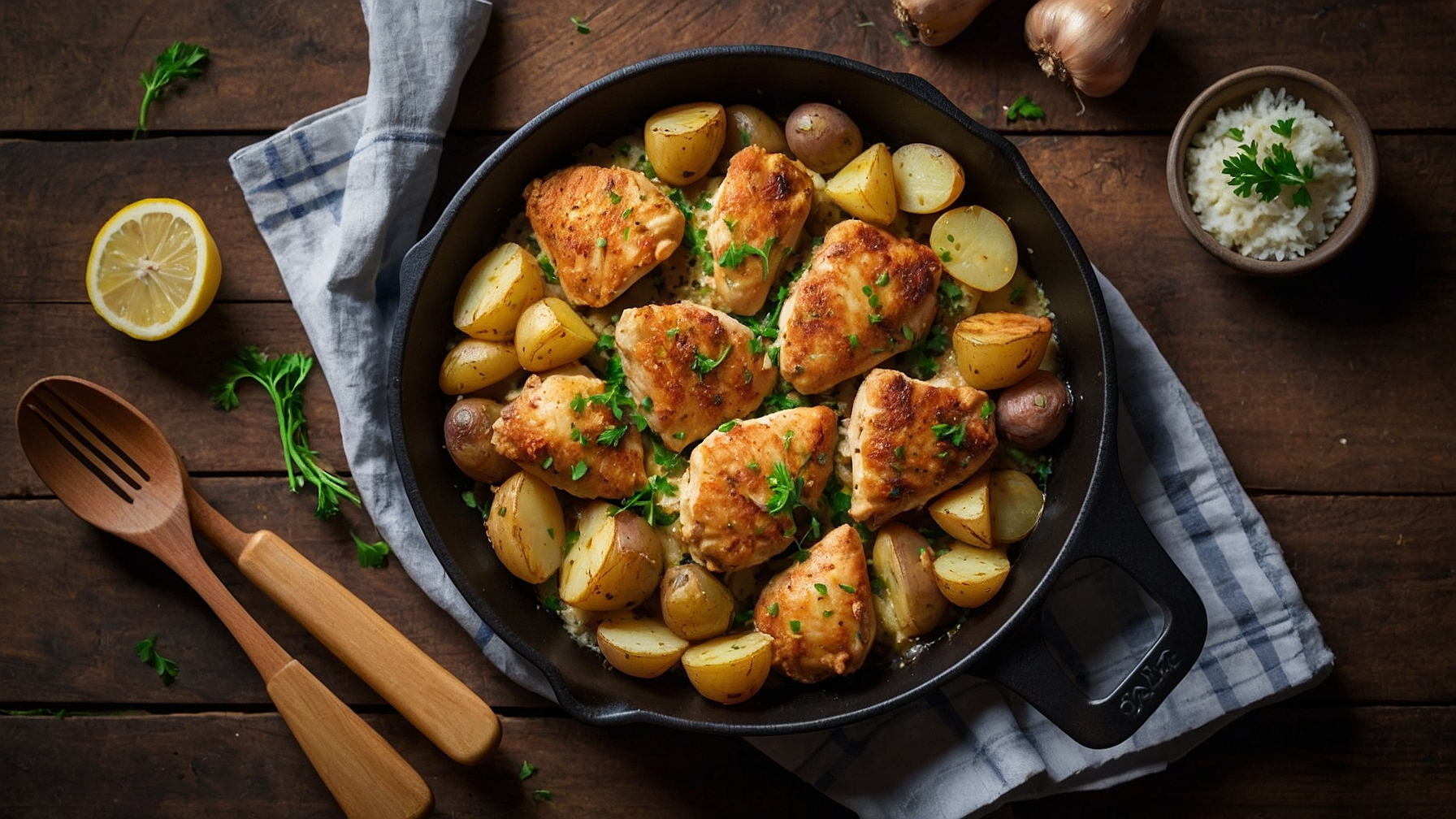
Prepare tender chicken and seasoned potatoes in a rich, creamy sauce, cooked entirely in one pan.
Ingredients
- 1.5 lbs (680g) boneless, skinless chicken thighs, trimmed and cut into uniform 1-inch (2.5 cm) cubes
- 1.5 lbs (680g) small baby potatoes, scrubbed and quartered
- 2 tbsp (30ml) extra virgin olive oil, divided
- 1 tsp (5g) fine sea salt, divided
- 0.5 tsp (2.5g) freshly ground black pepper, divided
- 1 tsp (5g) smoked paprika
- 0.5 tsp (2.5g) garlic powder
- 0.5 tsp (2.5g) dried Italian seasoning blend
- 2 tbsp (28g) unsalted butter, divided
- 4 large cloves garlic, finely minced
- 1 tbsp (8g) all-purpose flour
- 0.5 cup (120ml) low-sodium chicken broth
- 0.5 cup (120ml) heavy cream
- 0.5 cup (60g) freshly grated Parmesan cheese, plus extra for serving
- 2 tbsp (10g) fresh flat-leaf parsley, finely chopped
Instructions
- Prepare Chicken: Pat dry chicken thighs with paper towels. In a large bowl, combine cubed chicken with 1 tbsp (15ml) extra virgin olive oil, 0.5 tsp (2.5g) fine sea salt, 0.25 tsp (1.25g) freshly ground black pepper, 1 tsp (5g) smoked paprika, and 0.5 tsp (2.5g) garlic powder; toss until chicken is evenly coated.
- Season Potatoes: In a separate medium bowl, toss quartered baby potatoes with remaining 1 tbsp (15ml) extra virgin olive oil, 0.5 tsp (2.5g) fine sea salt, 0.25 tsp (1.25g) freshly ground black pepper, and 0.5 tsp (2.5g) dried Italian seasoning blend until potato surfaces are well coated.
- Heat Skillet: Place a large (12-inch / 30cm) oven-safe cast iron or heavy-bottomed skillet over medium-high heat for 2-3 minutes.
- Sear Chicken: Add seasoned chicken cubes to the hot skillet in a single layer, cooking in batches if necessary. Sear for 5-7 minutes, flipping once halfway, until golden brown and lightly seared on all sides; remove chicken and set aside.
- Cook Potatoes: Add 1 tbsp (14g) unsalted butter to the same skillet. Once melted, add seasoned potatoes. Cook for 15-20 minutes, stirring occasionally every 3-4 minutes, until potatoes are fork-tender and develop a crispy, golden-brown exterior.
- Sauté Aromatics: Reduce heat to medium. Add remaining 1 tbsp (14g) unsalted butter to the skillet with potatoes. Once melted, add minced garlic; sauté for 1 minute until fragrant and lightly golden.
- Create Roux: Sprinkle 1 tbsp (8g) all-purpose flour over garlic and butter. Stir constantly for 1 minute until flour incorporates and forms a light roux.
- Deglaze and Build Sauce Base: Pour in 0.5 cup (120ml) low-sodium chicken broth, immediately scraping skillet bottom to loosen browned bits (fond). Stir continuously for 1-2 minutes until liquid thickens and forms a smooth base.
- Add Cream and Cheese: Stir in 0.5 cup (120ml) heavy cream and 0.5 cup (60g) freshly grated Parmesan cheese. Cook, stirring frequently, for 2-3 minutes until sauce is smooth, creamy, and gently simmering, bubbling around edges.
- Combine and Finish Cooking: Return partially cooked chicken cubes to skillet, nestling among potatoes and coating with sauce. Simmer for 5-7 minutes, stirring occasionally, until chicken is fully cooked (165°F / 74°C internal temperature) and sauce clings to ingredients.
- Garnish and Serve: Remove skillet from heat. Garnish with 2 tbsp (10g) fresh finely chopped flat-leaf parsley. Serve immediately.
Notes
- Crispy Potatoes Tip: For crisp potatoes, preheat skillet thoroughly. Avoid overcrowding; cook potatoes in two batches if necessary.
- Skillet Alternative: If an oven-safe skillet is unavailable, transfer mixture to a baking dish after step 10. Bake in a preheated oven at 375°F (190°C) for 10-15 minutes until chicken is cooked through.
- Sauce Consistency: Adjust heavy cream or chicken broth in step 9 for desired consistency. Add additional broth for thinner sauce; add additional cream for thicker coating.
- Added Vegetables: Incorporate quick-cooking vegetables (e.g., bell peppers, green beans, spinach) during the last 5-7 minutes of potato cooking in step 5.
- Food Safety: Cook chicken to an internal temperature of 165°F (74°C). Use an instant-read meat thermometer inserted into the thickest part of the chicken.
Pro Tips for a Perfect Garlic Parmesan Skillet
Ingredient Tips
- Chicken Cut:Use boneless, skinless chicken thighs, cut into uniform 1.5-inch pieces. Their higher fat content ensures juicier results, cooking evenly in 3-4 minutes per side to an internal 165°F (74°C) without drying out.
- Potato Choice/Cut:Opt for waxy potatoes (Yukon Gold/red), diced into 1-inch cubes. Their lower starch prevents mushiness, yielding creamy interiors and crispy exteriors after 6-8 minutes browning. Avoid starchy Russets.
- Garlic Prep:Mince 6-8 large cloves of fresh garlic to approximately 1/8-inch pieces. This maximizes flavor release without the risk of rapid burning that very fine pastes or thin slices face in a hot pan.
- Parmesan Quality:Always use freshly grated Parmesan-Reggiano, about 1/2 cup (2 ounces). It melts smoothly into the sauce, providing rich, nutty depth, avoiding grainy textures from pre-shredded varieties.
- Butter Type:Utilize 4 tablespoons (1/4 cup) unsalted butter. This allows precise control over the dish’s sodium level, enabling you to adjust seasoning exactly to your preference.
Technique Tips
- Pre-heating Skillet:Heat a 12-inch heavy-bottomed skillet over medium-high heat for 3-4 minutes before adding oil. This ensures uniform high heat, creating a superior, non-stick sear on both chicken and potatoes and promoting even browning.
- Chicken Searing:Sear chicken pieces in a single layer (in batches if needed) for 3-4 minutes per side over medium-high heat. Cook until deeply golden brown with a rich, caramelized crust, reaching an internal 165°F (74°C).
- Potato Browning Strategy:After removing seared chicken, add 1-inch diced potatoes. Cook undisturbed for 6-8 minutes over medium heat, developing a substantial crispy, golden-brown crust on one side before flipping for even texture.
- Garlic Addition Timing:Introduce minced garlic after primary browning, sautéing for 30-60 seconds until intensely fragrant and slightly golden. Immediately add liquids to stop cooking and preserve its sweet aroma.
- Deglazing & Sauce Simmer:Deglaze with 1/2 cup low-sodium chicken broth, scraping vigorously for 1-2 minutes to release all flavorful browned bits (fond). Simmer for 8-10 minutes until the sauce slightly reduces and visibly coats the back of a spoon.
- Finishing with Parmesan:Remove skillet from heat before stirring in 1/2 cup (2 ounces) freshly grated Parmesan. Adding off-heat ensures the cheese melts into a smooth, emulsified sauce, preventing clumping or oiliness.
- Herb Addition:Incorporate 2-3 tablespoons fresh chopped herbs (parsley/chives) during the final 1-2 minutes of cooking or off-heat. This preserves their vibrant color and delicate aroma, adding a crucial burst of brightness.
Common Issues
- Dry Chicken:Overcooked chicken is dry. Remove pieces from the skillet as soon as they reach an internal 165°F (74°C) with an instant-read thermometer. Resting for 5-10 minutes also helps retain juices.
- Mushy Potatoes:This stems from overcrowding or insufficient heat. Ensure a single layer with 1/4-inch space, cooking over medium-high heat for 6-8 minutes per side to achieve crispy, golden exteriors and fork-tender interiors.
- Burnt Garlic:Garlic burns extremely fast. Add minced garlic after primary browning, sauté for only 30-60 seconds until aromatic and lightly golden, then immediately add liquid (broth) to halt cooking.
- Sauce Too Thin:If the sauce lacks body, simmer uncovered for an additional 3-5 minutes over medium heat. Allow excess liquid to evaporate, stirring, until the sauce visibly thickens and coats the back of a spoon.
- Sauce Too Thick/Clumpy:Gradually stir in 1-2 tablespoons warm chicken broth or water, one tablespoon at a time. This thins the sauce to your desired pourable consistency and helps re-emulsify any clumpy cheese.
How to Store, Reheat, and Delicious Variations
Refrigerator Storage
Duration: 5-7 days in airtight container
For optimal quality and safety, transfer any leftover Garlic Parmesan Chicken And Potatoes Skillet to an airtight glass or food-grade plastic container with a tight-fitting lid within two hours of cooking. Store promptly in the refrigerator. Over time, the flavors will meld further. However, textures evolve: potatoes soften, potentially becoming mushy by day 5. The chicken, while still flavorful, can dry slightly if reheated improperly. The creamy garlic parmesan sauce thickens in the cold but thins upon reheating. While safe for 5-7 days, peak quality and textural integrity are best within the first 3-4 days; after day 5, its initial freshness declines.
Freezer Storage
Duration: 2-3 months
Freezing is a viable option, though expect some texture changes. Cool completely, then portion into freezer-safe airtight containers or heavy-duty freezer bags, pressing out air to prevent freezer burn. Label with the date. To thaw, transfer to the refrigerator overnight (8-12 hours). Reheating directly from frozen in the oven is possible but increases cooking time significantly. Upon thawing and reheating, potatoes may become slightly mealy, and chicken a touch drier. Sauce consistency might change, sometimes appearing a little separated, but stirring usually remedies this.
Reheating Instructions
- Oven:Preheat oven to 350°F. Transfer leftovers to an oven-safe dish with 1-2 tablespoons broth or water, cover with foil. Bake 15-25 minutes until thoroughly heated and gently bubbling (internal 165°F). Remove foil last 5 minutes for crispier potatoes. This method best maintains moisture and ensures even reheating.
- Stovetop:For small portions, use a non-stick skillet over medium-low heat. Add 1 tablespoon broth or water, cover. Heat 5-10 minutes, stirring, until hot throughout (internal 165°F). This method helps the sauce re-emulsify nicely.
- Microwave:Quickest, but can dry chicken and rubberize potatoes. Transfer single portion to microwave-safe dish, add 1 teaspoon broth or water, cover loosely. Heat 60-90 second intervals, stirring, until steaming hot (internal 165°F). Convenient, but compromises texture.
Make-Ahead Tips
To streamline meal prep, several components can be prepped in advance. Marinate chicken breasts up to 24 hours prior; store in an airtight container in the fridge. Potatoes can be cut and par-boiled (5-7 minutes until tender-firm), then cooled and stored in an airtight container in the fridge for 2-3 days. The garlic parmesan sauce can also be made 1-2 days ahead and kept in a sealed jar in the fridge. Combine prepped ingredients when ready to cook, reducing active cooking time. Store all components separately to maintain quality.