
Italian Herb Cheese Bread: The Ultimate Side Dish
This Italian Herb Cheese Bread comes together effortlessly, transforming basic ingredients into a fragrant, cheesy side dish in under 20 minutes.
It requires just 6 pantry staples and a quick 5-minute hands-on preparation, resulting in a golden, bubbly top and soft, herb-infused interior.
This savory bread is an excellent accompaniment to rich pasta dishes, warm bowls of soup, crisp salads, or as a satisfying snack for any meal.
Italian Herb Cheese Bread
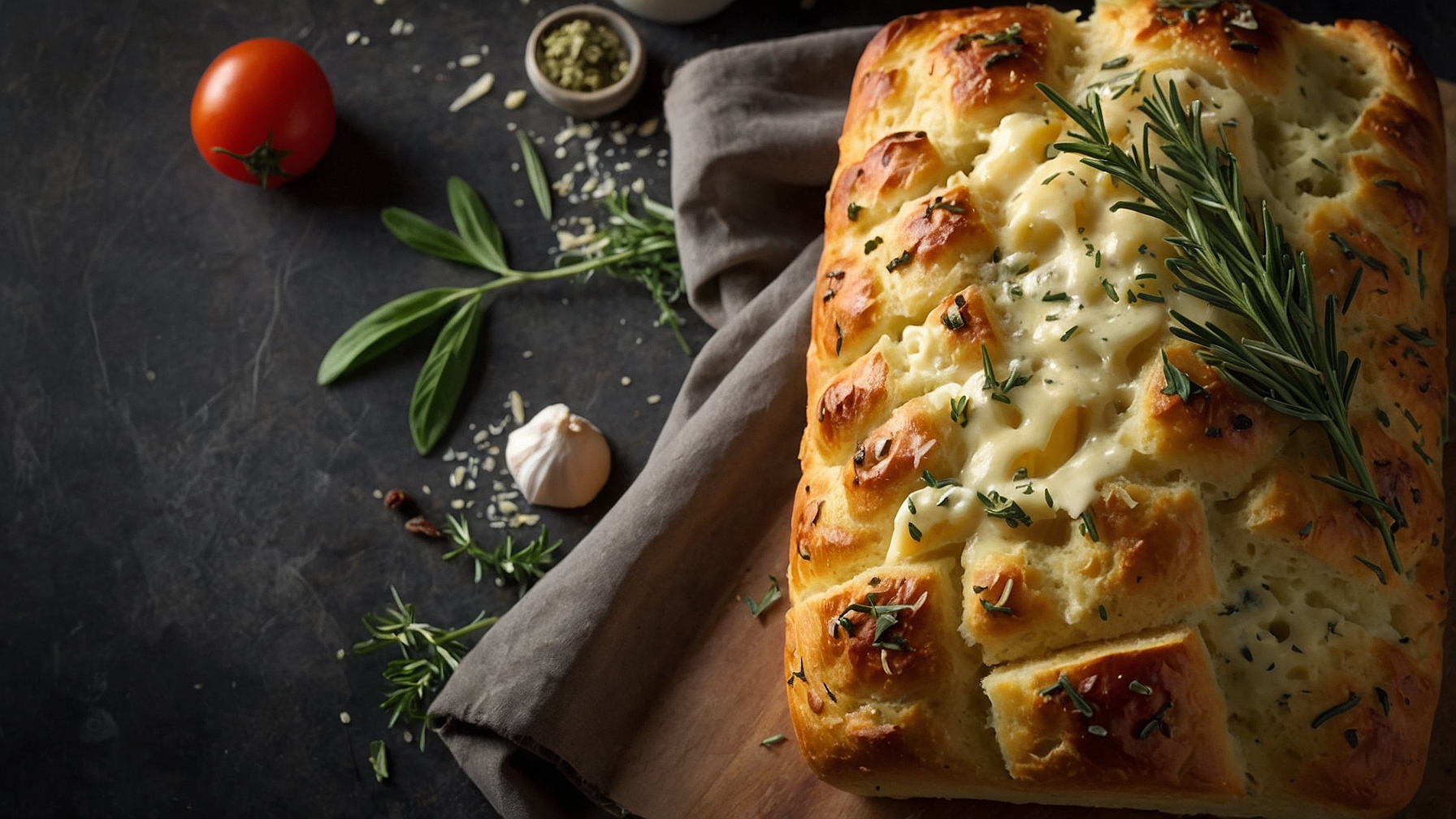
This Italian Herb Cheese Bread combines savory herbs and rich cheese into a single loaf, suitable for any meal or snack.
Ingredients
- 1 ½ cups (360ml) warm water, 105-115°F (40-46°C)
- 2 ¼ teaspoons (7g) active dry yeast, one standard packet
- 1 tablespoon (15g) granulated sugar
- 2 teaspoons (10g) fine sea salt
- ¼ cup (60ml) extra virgin olive oil, plus 1 teaspoon for greasing
- 4 ½ cups (540g) all-purpose flour, plus more for dusting
- 1 cup (113g) shredded low-moisture part-skim mozzarella cheese, divided
- ½ cup (50g) grated Parmesan cheese, divided
- 1 tablespoon (15ml) extra virgin olive oil, for filling
- 2 teaspoons (2g) dried oregano
- 2 teaspoons (2g) dried basil
- 1 teaspoon (2g) garlic powder
- 1 large egg, beaten
- 1 tablespoon (15ml) water, for egg wash
- 1 teaspoon (1g) dried Italian seasoning blend
Instructions
- Combine 1 ½ cups (360ml) warm water (105-115°F / 40-46°C), 2 ¼ teaspoons (7g) active dry yeast, and 1 tablespoon (15g) granulated sugar in a large mixing bowl. Stir 15 seconds until sugar dissolves. Let stand 5-10 minutes until mixture is foamy and bubbly.
- Stir 2 teaspoons (10g) fine sea salt and ¼ cup (60ml) extra virgin olive oil into the activated yeast mixture. Mix 30 seconds until combined and salt dissolves.
- Gradually add 4 ½ cups (540g) all-purpose flour to the wet ingredients. Mix with a wooden spoon or a stand mixer on low speed for 1-2 minutes until a shaggy dough forms and flour is incorporated.
- Turn dough onto a lightly floured surface. Knead 8-10 minutes by hand or with a stand mixer on medium-low speed until dough is smooth, elastic, and no longer sticky.
- Grease a large bowl with 1 teaspoon extra virgin olive oil. Place kneaded dough in the bowl, turning once to coat. Cover bowl with plastic wrap or a clean kitchen towel. Let rise in a warm, draft-free place for 60-90 minutes until doubled in size.
- While dough rises, combine ¾ cup (85g) shredded mozzarella cheese, ¼ cup (25g) grated Parmesan cheese, 1 tablespoon (15ml) extra virgin olive oil, 2 teaspoons (2g) dried oregano, 2 teaspoons (2g) dried basil, and 1 teaspoon (2g) garlic powder in a small bowl. Mix 30 seconds until herbs and oil are evenly distributed.
- Punch down risen dough to release air. Turn dough onto a lightly floured surface.
- Roll dough with a rolling pin into an 18×12 inch (45×30 cm) rectangle, ¼ inch (0.6 cm) thick. Sprinkle filling evenly over the surface, leaving a ½ inch (1.25 cm) border.
- Starting from a long side, tightly roll dough into a log. Pinch seam closed. Pinch ends of log to seal.
- Transfer dough log to a parchment-lined 9×5 inch (23×13 cm) loaf pan. Place seam-side down.
- Cover loaf pan with plastic wrap or a clean kitchen towel. Let dough rise in a warm, draft-free place for 30-45 minutes until almost doubled in size and puffy.
- While dough rises, preheat oven to 375°F (190°C). Position oven rack in the center.
- Whisk 1 large beaten egg and 1 tablespoon (15ml) water in a small bowl.
- After second rise, brush loaf top with egg wash. Sprinkle ¼ cup (28g) reserved shredded mozzarella cheese, ¼ cup (25g) reserved grated Parmesan cheese, and 1 teaspoon (1g) dried Italian seasoning blend over the loaf.
- Bake bread 30-35 minutes until crust is golden brown. Tap bottom for a hollow sound. An instant-read thermometer inserted into the center should register 200-210°F (93-99°C).
- Remove loaf pan from oven. Cool bread in pan for 10-15 minutes.
- Remove bread from loaf pan. Transfer to a wire rack. Cool for 30-60 minutes before slicing.
Notes
- Yeast Activity: Water temperature (105-115°F / 40-46°C) is critical for yeast activation. Foaming within 5-10 minutes confirms activity.
- Kneading Technique: Knead dough until smooth, elastic, and it passes the windowpane test (stretch a small piece thinly enough to see light through it without tearing).
- Rising Environment: Use a warm, draft-free spot. For a cool kitchen, place covered dough in an unheated oven with the light on, or in a turned-off microwave with hot water.
- Storage: Store bread at room temperature in an airtight container for 3-4 days. For longer storage, slice and freeze in an airtight bag for up to 3 months. Reheat slices in a toaster or oven.
- Cheese Variation: Use low-moisture cheeses (provolone, Gruyère, sharp white cheddar) for best texture.
- Herb Substitution: Substitute 1 tablespoon (5g) fresh chopped oregano and 1 tablespoon (5g) fresh chopped basil for dried herbs.
- Doneness Check: A hollow sound when tapping the bottom or an internal temperature of 200-210°F (93-99°C) confirms doneness.
Pro Tips for Perfect Italian Herb Cheese Bread
Ingredient Tips
- Yeast Activation:Dissolve 2 1/4 tsp active dry yeast in 1/2 cup warm water (105-115°F / 40-46°C) for 5-10 minutes. Ensure it’s visibly foamy for a robust rise.
- Flour Choice:Use 3 1/2 cups high-protein bread flour (12-14% protein). This builds stronger gluten, yielding a chewier crumb and better structure.
- Optimal Cheese Blend:Combine 1 1/2 cups shredded low-moisture mozzarella with 1/2 cup grated Parmesan for optimal melt and crucial salty depth.
- Herb Potency:Incorporate 2 tbsp chopped fresh oregano and 1 tbsp fresh basil. For dried herbs, use 2 tsp oregano and 1 tsp basil for equivalent potency.
- Milk Temperature:Warm 1 cup whole milk to 95-100°F (35-38°C). This gentle warmth activates yeast optimally, ensuring a consistent, airy crumb.
Technique Tips
- Effective Kneading:Knead for 8-10 minutes (mixer speed 2-3) or 12-15 minutes by hand until dough is smooth, elastic, and passes the windowpane test.
- First Proofing:Rise dough in a warm spot (75-80°F / 24-27°C) for 60-90 minutes until doubled in size; a poke leaves an indentation that slowly springs back.
- Cheese Distribution:Press 1 cup of cheese blend into the dough as you fold it 3-4 times during shaping, ensuring uniform distribution throughout the loaf.
- Second Proof:Place shaped loaf in a greased 9×5 inch pan. Proof 30-45 minutes in a warm area until it increases by 50% and feels noticeably lighter.
- Two-Stage Baking:Bake at 375°F (190°C) for 20 minutes. Then, sprinkle remaining 1 cup cheese and bake 15-20 minutes until golden brown and bubbling at edges.
Common Issues
- Dense Loaf:If bread is dense/unrisen, it’s under-proofed. Extend first proof by 20-30 minutes until dough doubles and a poke leaves a persistent indentation.
- Dry Texture:Dryness signals insufficient hydration. Add an extra 1-2 tbsp warm water (105-115°F / 40-46°C) to mixing dough if stiff, aiming for slight stickiness.
- Burning Cheese Topping:Delay adding 1 cup topping until the last 15-20 minutes of baking. Or, tent with foil after 25 minutes if browning too fast.
- Weak Herb Flavor:For bolder flavor, increase dried quantities by 1/2 tsp each (e.g., 2.5 tsp oregano, 1.5 tsp basil) or fresh herbs by 1 tbsp total.
- Overly Sticky Dough:If dough is too sticky post-kneading, gradually incorporate 1-2 tbsp more bread flour until it pulls cleanly from the bowl.
How to Store, Reheat, and Serve Your Italian Herb Cheese Bread
Refrigerator Storage
Duration: 3-4 days for optimal quality, up to 5 days safely
Store your Italian Herb Cheese Bread in an airtight glass or heavy-duty plastic container, or wrap tightly in plastic wrap and then foil. While safe for up to 5 days, the vibrant herb aroma lessens after day 2. Expect the cheese to firm up and the bread to lose its initial crispness, becoming chewier or slightly drier. For best flavor and texture, consume within 3-4 days; quality declines noticeably thereafter.
Freezer Storage
Duration: 2-3 months
Ensure bread is completely cooled before freezing. Wrap individual slices or the whole loaf tightly in aluminum foil, then place inside a heavy-duty freezer-safe bag, expelling as much air as possible. This double-layer method prevents freezer burn. Thaw a whole loaf in the refrigerator overnight (8-12 hours) or on the countertop for 2-3 hours. Slices can be reheated directly from frozen, or thawed on the countertop for 30 minutes. Expect the bread to be slightly drier upon reheating, and the cheese might not achieve the same gooey stretchiness as fresh.
Reheating Instructions
- Oven (Best Method):Preheat oven to 350°F (175°C). For a thawed whole loaf, place on a baking sheet and reheat for 15-20 minutes. Thawed slices require 8-10 minutes, while frozen slices need 12-15 minutes. Ready when cheese is melted and bubbly, and edges are slightly crispy. This method yields the best texture, returning the bread to a near-fresh state.
- Toaster Oven (Excellent for Slices):Place thawed slices on the tray; set to 350°F (175°C) for 5-7 minutes. Frozen slices take 8-10 minutes. Watch closely. Ready when cheese is bubbly and bread is crisp. Excellent for individual servings, restoring crispness.
- Microwave (Quick but Compromises Texture):For a thawed slice, heat on high for 20-30 seconds. For a frozen slice, heat for 45-60 seconds. This quickest option warms the bread but can make it soft, chewy, and less crisp, with rubbery cheese instead of gooey. Acceptable for speed, but not for optimal texture or flavor.
Make-Ahead Tips
The seasoned herb-butter mixture can be prepared up to 2 days in advance and stored in an airtight container in the refrigerator. Allow it to come to room temperature for easier spreading before assembly. While assembling and chilling unbaked bread for a few hours is possible, the best make-ahead strategy for optimal quality is to fully bake the bread, cool it completely, and then freeze it using the method described above. Freezing the fully baked bread preserves its texture and flavor most effectively. Reheat from frozen or thawed using oven or toaster oven instructions.