
Simple Roast Beef: Your Guide to a Perfect Sunday Dinner
Achieve perfectly tender, flavorful roast beef with minimal effort and just a few basic ingredients.
It requires just 4 core ingredients and less than 15 minutes of active prep time for a rich, savory main course.
Perfect for a comforting Sunday dinner, a special occasion, or simply for delicious sandwich meat throughout the week.
Simple Roast Beef
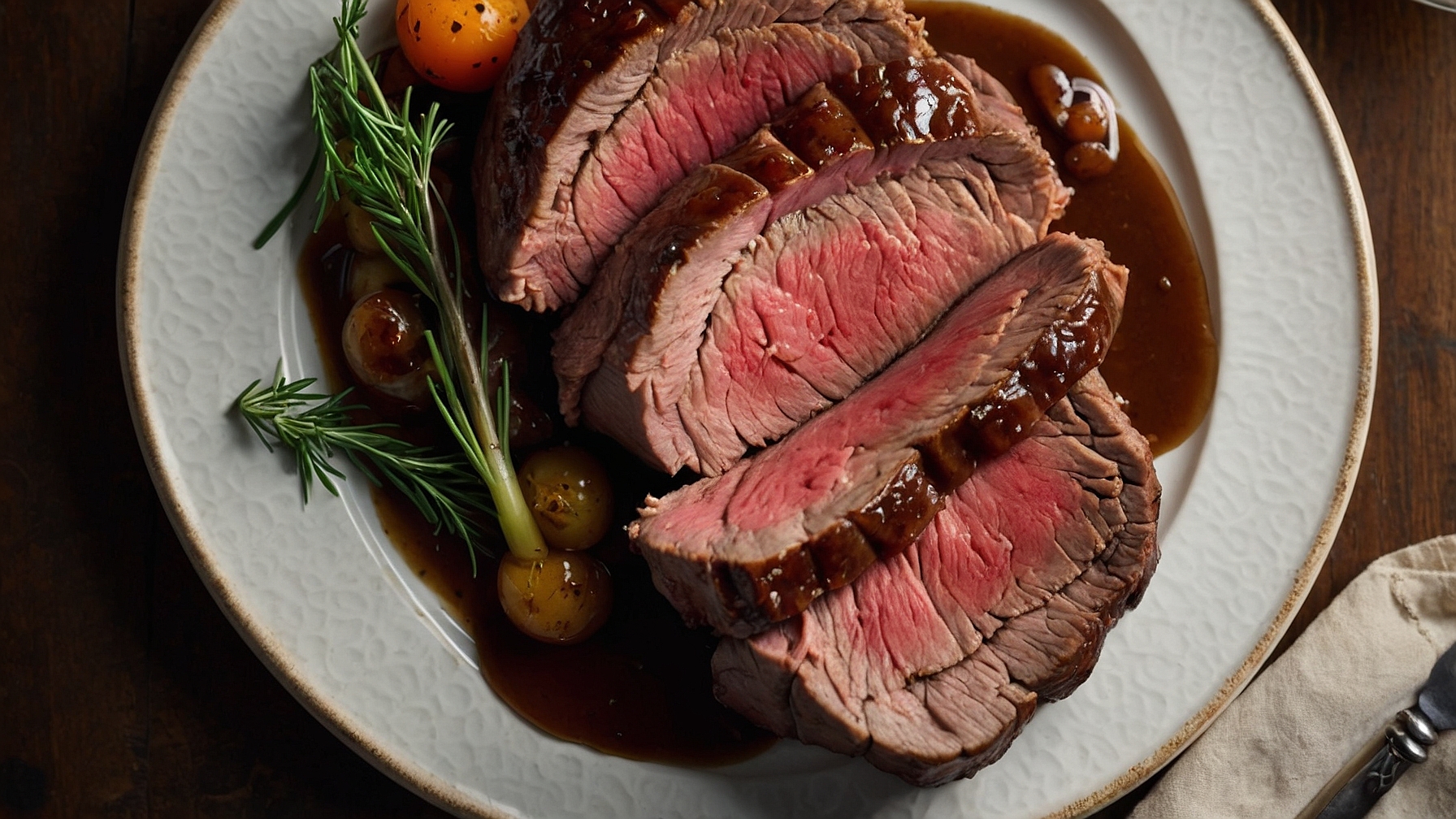
Prepare tender roast beef with a savory crust.
Ingredients
For the Roast
- 1 (3.5 lb / 1.6 kg) boneless beef ribeye roast, choice or prime grade
For the Dry Rub
- 2 tbsp (30ml) extra virgin olive oil
- 2 tsp (10g) coarse sea salt or kosher salt
- 1 tsp (5g) freshly ground black pepper
- 1 tsp (5g) garlic powder
- 1 tsp (5g) onion powder
- 1 tsp (2g) dried rosemary, finely crushed
- 1 tsp (2g) dried thyme leaves
For the Roasting Pan (Optional)
- 1 large (180g) yellow onion, peeled and cut into 1-inch (2.5 cm) wedges
- 2 sprigs fresh rosemary, roughly broken
- 4 sprigs fresh thyme, left whole
- 1 cup (240ml) beef broth or water
Instructions
- Remove roast from packaging 2-3 hours before cooking; bring to room temperature. Pat roast surface thoroughly dry with paper towels.
- Combine olive oil, sea salt, black pepper, garlic powder, onion powder, crushed rosemary, and thyme leaves in a small bowl. Stir until a uniform paste forms.
- Apply dry rub mixture over the entire roast surface. Massage rub into the meat for complete coverage.
- Position oven rack in the center. If using, place 1-inch (2.5 cm) onion wedges, 2 fresh rosemary sprigs, and 4 fresh thyme sprigs into a roasting pan. Pour 1 cup (240ml) beef broth or water into the pan bottom.
- Preheat oven to 450°F (230°C).
- Place seasoned roast onto the oven rack, fat-side up, within the roasting pan. Roast for 15 minutes at 450°F (230°C) until exterior browns.
- Reduce oven temperature to 325°F (160°C) without opening the door. Continue roasting 45-60 minutes until an instant-read thermometer inserted into the thickest part registers 120-125°F (49-52°C) for rare or 130-135°F (54-57°C) for medium-rare.
- Remove roasting pan from oven. Transfer roast to a cutting board. Tent roast with aluminum foil. Rest 15-20 minutes.
- Remove kitchen twine, if present. Slice roast beef thinly against the grain with a sharp knife. Arrange slices on a platter. Serve immediately.
Notes
- Internal Temperature Guide: Use an instant-read meat thermometer for precise doneness. Temperature rises 5-10°F (3-6°C) during resting.
- Rare: 120-125°F (49-52°C) removed from oven.
- Medium-Rare: 130-135°F (54-57°C) removed from oven.
- Medium: 135-140°F (57-60°C) removed from oven.
- Medium-Well: 145-150°F (63-66°C) removed from oven.
- Tying the Roast: If untied, use kitchen twine to tie the roast at 1-inch (2.5 cm) intervals.
- Pan Drippings for Gravy: For pan gravy: Strain liquid from roasting pan into a saucepan. Skim excess fat. Bring to a simmer over medium heat. Whisk in a slurry of 1 tbsp (8g) cornstarch or 2 tbsp (16g) flour mixed with 2 tbsp (30ml) cold water. Simmer 2-3 minutes until thickened.
- Storage: Store leftover roast beef in an airtight container in the refrigerator for 3-4 days. Reheat thinly sliced beef gently in a pan with beef broth.
- Altitude Adjustment: Adjust cooking times for elevations above 3,000 feet (900 meters). Monitor internal temperature with a thermometer.
- Oven Calibration: Use an oven thermometer to verify oven temperature accuracy at 450°F (230°C) and 325°F (160°C).
- Meat Quality: Select ‘Choice’ or ‘Prime’ grade ribeye roast for optimal tenderness and flavor.
Pro Tips for Perfect Roast Beef
Ingredient Tips
- Roast Selection:Opt for a 3 to 4-pound boneless beef eye of round or top round roast. Its lean muscle and uniform shape ensure consistent cooking results.
- Room Temperature Prep:Remove the roast from the refrigerator 1 to 2 hours before cooking. This allows even internal heating and a faster, more predictable cook time.
- Generous Seasoning:Season liberally with 2 to 3 teaspoons coarse salt and 1 teaspoon fresh black pepper per pound, ensuring deep flavor penetration beyond the surface.
- Aromatic Infusion:Place 3 to 4 crushed garlic cloves and 1 to 2 sprigs fresh rosemary directly in the roasting pan. Their essence will permeate the environment, not just the meat.
- Dry Surface:Pat the entire roast thoroughly dry with 3 to 4 sheets of paper towel before seasoning. Any moisture will steam, preventing a deep, golden brown crust.
Technique Tips
- High-Heat Searing:Sear the roast for 3 to 4 minutes per side in an oven-safe skillet over medium-high heat until deeply golden brown, creating a flavorful crust.
- Initial Roast Temperature:Start roasting at 450°F for exactly 15 minutes. This creates a thermal shock, quickly forming an exterior while setting the internal cook.
- Reduced Roasting:After initial high-heat, reduce oven to 325°F. Continue roasting until internal temperature reaches desired doneness, ensuring gentle, even cooking.
- Precise Doneness:Use an instant-read thermometer, aiming for 120-125°F (rare), 125-130°F (medium-rare), or 130-135°F (medium), inserted into the thickest part.
- Crucial Resting Period:Rest the roast, tented with foil, for a minimum of 15 to 20 minutes after oven removal. Juices redistribute, increasing tenderness by up to 15%.
- Thin Slicing:Use a very sharp carving knife to slice thinly against the grain, aiming for uniform 1/8 to 1/4 inch thick slices, maximizing tenderness and ease of chewing.
Common Issues
- Dry, Overcooked Roast:Remove roast 5 to 7°F below target internal temperature (e.g., 115°F for rare). Residual heat will cause carry-over cooking, reaching perfection while resting.
- Unevenly Cooked Ends:If roast is irregularly shaped, tie it tightly with butcher’s twine at 1-inch intervals. This creates a uniform cylinder for even heat penetration and consistent doneness.
- Lackluster Crust:Ensure searing pan is very hot (smoke just beginning). Use 1 tablespoon high-smoke point oil. Sear each side for full 3 to 4 minutes for a deep golden brown, flavorful exterior.
- Tough Texture:Always identify the meat’s grain and slice strictly perpendicular to it. Cutting against the grain shortens muscle fibers, making the roast significantly more tender.
- Juices Leaking During Carving:The roast must rest for at least 15 minutes before carving. Cutting too soon allows up to 30% of flavorful juices to run out, resulting in a drier roast.
How to Store and Reheat Simple Roast Beef
Refrigerator Storage
Duration: 5-7 days in airtight container
Store leftover Simple Roast Beef in an airtight glass container or wrapped tightly in heavy-duty plastic wrap, followed by aluminum foil, to prevent exposure to air and fridge odors. For optimal quality and moisture retention, consume within 5 days, though it remains safe to eat for up to 7 days if properly stored. Storing the beef as a whole piece (if not already sliced) can help retain moisture, though pre-sliced beef cools faster and allows for easier portioning. Over time, the roast beef will lose some of its initial vibrant flavor and fresh aroma, becoming slightly drier and the texture firming up. The vibrant pink color may also dull slightly.
Freezer Storage
Duration: 2-3 months
For longer storage, Simple Roast Beef freezes well for 2-3 months. To freeze, allow the beef to cool completely. Slice the beef into desired serving portions – thinner slices often freeze and thaw more efficiently. Wrap each portion tightly in plastic wrap, then a layer of aluminum foil, and place into a freezer-safe, airtight bag, expelling as much air as possible. Label with the date. Thaw frozen roast beef slowly in the refrigerator overnight, typically requiring 12-24 hours depending on the amount. Avoid thawing at room temperature for food safety. Expect the texture to become slightly firmer and potentially a bit drier after freezing and thawing. The delicate medium-rare quality may be compromised, making it better suited for dishes where its texture is less critical, such as sandwiches or hash.
Reheating Instructions
- Oven (Best):Preheat your oven to a low 250°F (120°C). Place the beef in an oven-safe dish with a splash of beef broth or water, covering tightly with foil. Reheat slices for 15-25 minutes, or larger pieces for 25-40 minutes, until just warmed through. Aim for an internal temperature of 120-130°F (49-54°C) for medium-rare without overcooking. The beef should be warm to the touch and retain its pink center. This method gently warms the beef, preserving its tenderness and moisture.
- Stovetop (Good for slices):For individual slices, gently warm them in a non-stick skillet over medium-low heat with a small amount of beef broth or neutral oil. Cook for 1-2 minutes per side, just until heated through. Avoid high heat or overcrowding to prevent drying and toughening. The slices should be warm and remain pliable.
- Microwave (Acceptable, but may change texture):If convenience is paramount, place slices in a microwave-safe dish with a tablespoon of broth or water, cover, and heat on medium power in 30-60 second intervals, checking frequently. While quick, this method can make the beef rubbery or tough, diminishing its juiciness and delicate texture.
Rating: The oven works best for maintaining tenderness and even heating. The stovetop is good for quick, single-serving slices. The microwave is acceptable for speed but may noticeably change the texture and juiciness of the beef, making it chewier.
Make-Ahead Tips
Simple Roast Beef is an excellent make-ahead meal component. You can roast the beef up to 1-2 days in advance for peak quality. Once cooked, allow it to cool completely before storing it as a whole piece, tightly wrapped in heavy-duty plastic wrap and then foil, in the coldest part of your refrigerator. This helps retain moisture. If preparing gravy or a jus, make and store it separately in an airtight container in the fridge. Slice the beef just before serving or reheating to help maintain its juiciness and prevent excessive drying.