
Quick And Easy Homemade Mayonnaise: Skip the Jar!
Achieve fresh, vibrant homemade mayonnaise in just minutes, effortlessly elevating your meals.
This recipe requires only 5 common pantry ingredients and comes together in under 2 minutes using an immersion blender, ensuring a perfect emulsion every time.
Ideal for sandwiches, salads, or as a dipping sauce, this quick preparation provides a superior flavor and texture to store-bought options, giving you full control over ingredients.
Quick And Easy Homemade Mayonnaise
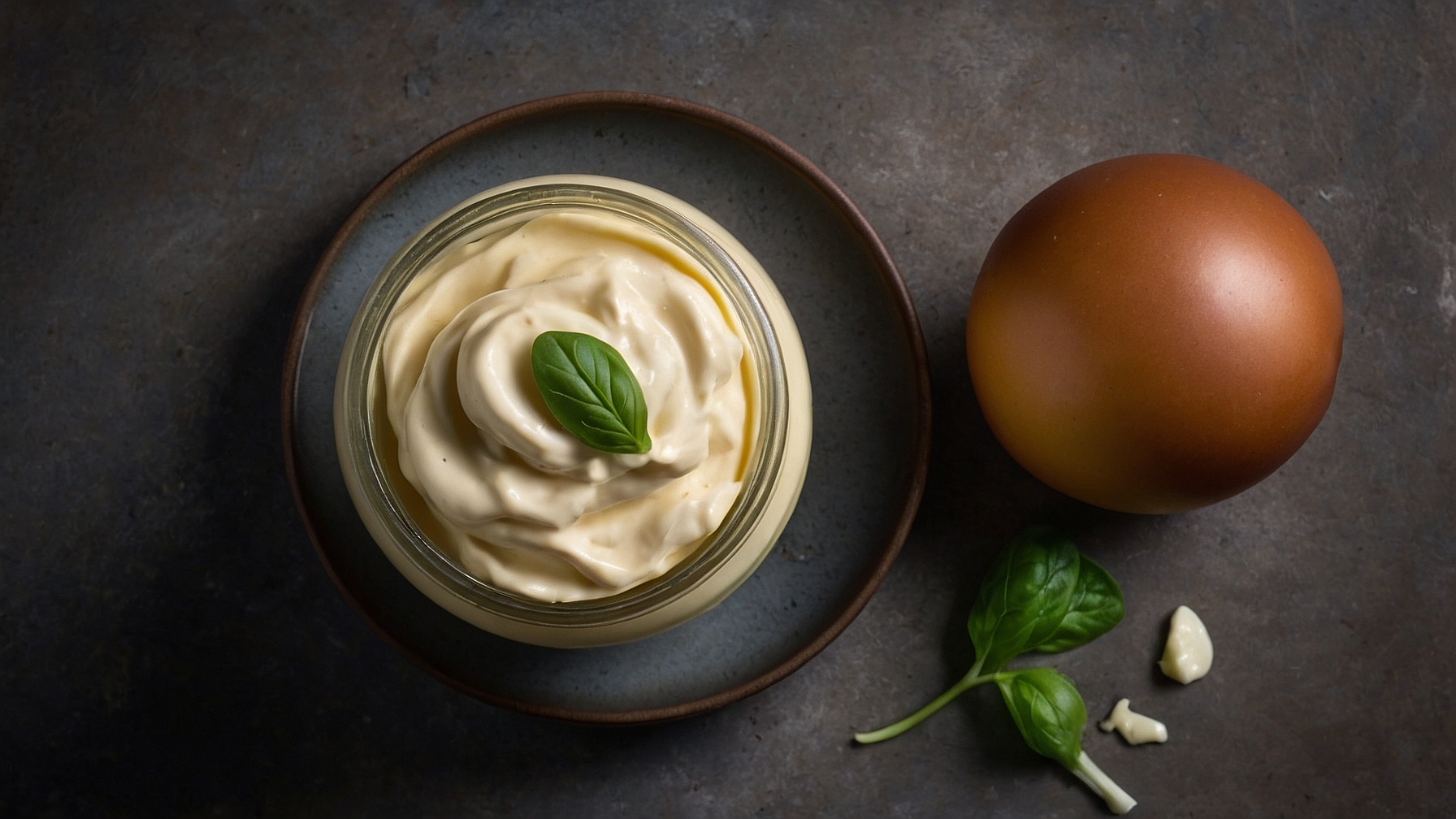
Create homemade mayonnaise in minutes with this complete recipe card, including ingredients, instructions, and timing.
Ingredients
- 1 large egg yolk, at room temperature
- 1 cup (240ml) neutral-flavored oil (grapeseed, canola, or sunflower oil), at room temperature
- 1 teaspoon (5ml) Dijon mustard
- 1 tablespoon (15ml) fresh lemon juice or white wine vinegar
- 1/2 teaspoon (2.5g) fine sea salt
- 1/4 teaspoon (0.6g) freshly ground black pepper
Instructions
- Ensure all ingredients are at 68-72°F (20-22°C). Place 1 large egg yolk, 1 teaspoon (5ml) Dijon mustard, 1 tablespoon (15ml) fresh lemon juice (or white wine vinegar), 1/2 teaspoon (2.5g) fine sea salt, and 1/4 teaspoon (0.6g) black pepper into a wide-mouth jar or immersion blender beaker.
- Pour 1 cup (240ml) neutral-flavored oil directly over the ingredients in the jar. Do not stir; the oil must remain a separate layer.
- Insert the immersion blender to the jar bottom, ensuring the blade head covers the egg mixture. Turn blender on high speed and hold steady for 15-20 seconds until a pale yellow, thick emulsion forms at the base.
- Slowly lift the immersion blender upwards through the oil over 10-15 seconds. Continue blending until all oil incorporates, and mayonnaise is thick, smooth, pale yellow, with no oil streaks.
- Taste the mayonnaise. Adjust seasoning by stirring in 1/4 teaspoon (1.25g) salt, or additional lemon juice (or vinegar), or black pepper, as needed.
- Transfer mayonnaise to an airtight container. Refrigerate for at least 30 minutes before serving to firm up.
Notes
- Ensure all ingredients are 68-72°F (20-22°C) for proper emulsification. Cold ingredients cause broken or thin mayonnaise. Remove ingredients from refrigerator 30-60 minutes prior, or warm egg in shell for a few minutes in warm water.
- Use neutral oils (grapeseed, sunflower, canola, or light olive oil) for a classic flavor. Extra virgin olive oil can impart a strong, bitter flavor. For a subtle olive oil note, use 3/4 cup (180ml) neutral oil with 1/4 cup (60ml) extra virgin olive oil.
- If mayonnaise is thin, it indicates a broken emulsion. Whisk a fresh egg yolk and 1 teaspoon (5ml) Dijon mustard in a clean bowl. Slowly whisk or blend the thin mayonnaise into the new egg yolk, drop by drop, until thick.
- If mayonnaise curdles, separating into oil and liquid, start with a fresh egg yolk and 1 teaspoon (5ml) Dijon mustard in a clean container. Gradually whisk or blend in the broken mixture, adding drops slowly, to rebuild the emulsion.
- For garlic mayo (aioli), add 1-2 finely minced garlic cloves (5-10g) in step 1, or blend in 1-2 teaspoons (5-10ml) roasted garlic paste after emulsification.
- For herb mayo, fold in 1-2 tablespoons (15-30g) finely chopped fresh herbs (chives, dill, parsley, tarragon) after emulsification.
- For spicy mayo, whisk in 1-2 teaspoons (5-10ml) Sriracha, chipotle powder, or hot sauce after emulsification. Adjust to taste.
- To use a whisk: Vigorously whisk egg yolk, mustard, lemon juice, salt, and pepper in a medium bowl until light and frothy. Slowly add oil, drop by drop, while continuously whisking. Once 1/4 cup (60ml) oil incorporates and mixture thickens, add remaining oil in a thin, steady stream, whisking constantly until thick and creamy.
- Store homemade mayonnaise in an airtight container in the refrigerator. Consume within 5-7 days. Discard if odor or discoloration occurs.
- This recipe uses raw egg yolks. A small risk of salmonella exists. Use fresh, high-quality eggs. Pregnant, elderly, immunocompromised individuals, or those serving young children should use pasteurized egg yolks or an egg-free recipe.
Pro Tips for Perfect Homemade Mayonnaise Every Time
Ingredient Tips
- Egg Yolk & Oil Temperature Control:Crucially, ensure both your large egg yolk (1 unit) and 1 cup (240ml) of neutral oil (e.g., grapeseed, canola) are at room temperature, specifically between 68-72°F (20-22°C). Allow them to sit out for at least 30-45 minutes. This temperature consistency is vital for the lecithin in the yolk to efficiently bind with the oil, creating a stable emulsion that thickens reliably and appears uniformly creamy, rather than thin or separated.
- Mustard’s Emulsifying Power:Integrate 1/2 teaspoon of Dijon mustard directly with the egg yolk. Dijon mustard contains mucilage, a natural emulsifier that significantly boosts the mayonnaise’s stability and speeds up the emulsification process. It helps ensure that oil droplets disperse evenly and bind quickly, leading to a smooth, cohesive texture that begins to visibly thicken within the first 15-20 seconds of blending/whisking.
Technique Tips
- Immersion Blender Method (Rapid Emulsification):For a quick, foolproof method, place 1 large egg, 1 tablespoon fresh lemon juice, 1/2 teaspoon Dijon mustard, 1/4 teaspoon fine sea salt, and finally 1 cup (240ml) of neutral oil into a tall, narrow container. Insert the immersion blender head directly to the bottom. Blend on high for 15-20 seconds without moving the blender, observing a thick, pale yellow emulsion forming at the base. Slowly lift the blender over 5-10 seconds, allowing all the oil to be incorporated until the entire mixture transforms into a uniform, opaque, and visibly creamy sauce that “slides off the spoon” in a thick ribbon.
- Slow Oil Drizzle (Whisk/Food Processor):If using a whisk or food processor, the initial oil addition is paramount. After combining the yolk, mustard, and acid, begin adding 1 cup (240ml) of oil at an excruciatingly slow rate – just 1 drop per second for the first 1/4 cup (60ml). This deliberate pace allows the emulsion to establish itself properly, preventing it from breaking. You’ll notice the mixture becoming significantly paler and thicker, capable of holding soft peaks, before you can increase the drizzle to a very thin, continuous stream (approximately 1/4 teaspoon per second) for the remaining oil.
- Consistent Agitation:Whether whisking by hand or using a machine, maintain consistent and rapid agitation throughout the oil incorporation. For hand whisking, aim for 180-200 vigorous strokes per minute for 5-7 minutes. For a food processor, use a medium-high speed setting. This continuous, high-shear mixing ensures that oil droplets are finely dispersed and uniformly suspended, yielding a glossy, homogenous mayonnaise that maintains its firm, “dollop-able” shape, even when gently scooped.
Common Issues
- Broken Mayonnaise Rescue:If your mayonnaise separates into a soupy, oily mess (often due to adding oil too fast), don’t panic. In a clean bowl, whisk 1 fresh egg yolk with 1 tablespoon of hot water (around 120-140°F / 49-60°C) for 20-30 seconds until slightly foamy. Then, very slowly, drizzle the broken mayonnaise into this new yolk mixture, starting with 1/2 teaspoon at a time, whisking continuously. The emulsion should visibly re-establish itself, becoming thick and creamy again within 2-3 minutes as you incorporate the remaining broken mixture.
- Thin Mayonnaise Thickening:If your mayonnaise is too thin after adding all the oil (e.g., it flows easily from a spoon), it needs more fat to reach optimal thickness. Gradually whisk or blend in an additional 1/4 to 1/2 cup (60-120ml) of neutral oil, 1/4 teaspoon at a time, over 2-4 minutes. Continue this slow addition until the mayonnaise visibly thickens to a consistency that holds its shape and leaves clear tracks when stirred, indicating proper emulsification has occurred.
- Flavor Imbalance (Tart/Bland):For an overly tart mayonnaise, whisk in 1/4 teaspoon of granulated sugar; the sweetness effectively cuts through excessive acidity. If it tastes bland, add an extra 1/8 to 1/4 teaspoon of fine sea salt and mix for 15 seconds. These small, measured adjustments significantly enhance the overall flavor profile, ensuring a perfectly balanced mayonnaise.
Flavorful Variations and Safe Storage for Your Homemade Mayonnaise
Crafting Quick And Easy Homemade Mayonnaise offers a fresh, vibrant alternative to store-bought versions. To enjoy its rich, creamy texture and superior flavor safely, understanding proper storage and handling, especially concerning warming or reheating, is crucial. Homemade mayonnaise, due to its raw egg base and lack of commercial preservatives, requires more careful attention than its factory-produced counterparts.
Refrigerator Storage
Duration: 5-7 days in an airtight glass container
Store your freshly made mayonnaise immediately in a clean, airtight glass jar or container. When first chilled, the mayonnaise will firm up slightly and become even thicker, enhancing its spreadability. Over time, especially after 3-4 days, the bright, piquant notes from fresh lemon juice or added herbs may begin to mellow and fade. By day 5-7, you might observe a slight loosening of the emulsion, appearing as a thin layer of oil on the surface, and the overall flavor will become less vibrant, leaning towards a duller, richer profile. Beyond 7 days, the quality rapidly diminishes, and due to the raw egg content, the risk of spoilage increases significantly. Always use clean utensils to scoop out mayonnaise to prevent introducing contaminants that shorten its shelf life.
Freezer Storage
Duration: Not recommended for optimal quality; if absolutely necessary, 1-2 months
Freezing homemade mayonnaise is generally not recommended if you desire to preserve its original smooth, creamy texture. The emulsion, which is a delicate balance of oil and water, will almost certainly break upon freezing and thawing. If you must freeze it, pour the mayonnaise into small, freezer-safe, airtight containers, leaving about ½ inch of headspace to allow for expansion. Thaw the frozen mayonnaise slowly in the refrigerator overnight (8-12 hours). After thawing, you will notice a significant change: the mayonnaise will appear oily, curdled, and watery, having lost its emulsified structure. While still safe to consume, its texture will be unsuitable for direct spreading or dipping. It is best used in cooked applications where its texture won’t be noticeable, such as mixed into mashed potatoes, as a binder in meatballs, or within baked casseroles.
Reheating Instructions and Warm Applications
Homemade mayonnaise itself does not reheat well; direct heat will cause the emulsion to break, resulting in an oily, separated mixture. The following instructions pertain to restoring slightly separated cold mayonnaise or incorporating it into dishes that require warming.
- Restoring Slightly Separated Cold Mayonnaise (No Heat):If your refrigerated mayonnaise shows minor separation or appears slightly grainy, do not heat it. Instead, spoon the affected mayonnaise into a clean bowl and vigorously whisk in 1 teaspoon of very hot water or a fresh egg yolk until the emulsion re-forms and the mayonnaise regains its creamy texture. This method is effective for reviving cold mayo.
- Incorporating into Baked Dishes (e.g., Casseroles):If homemade mayonnaise is an ingredient within a larger dish like a casserole or gratin, reheat the entire dish in an oven preheated to 350°F for 15-20 minutes, or until it is heated through and bubbling at the edges. The mayonnaise will contribute richness and moisture to the dish but will not retain its original emulsified structure once cooked.
- For Quick Warming of Dishes (e.g., Melt Sandwiches):For items like tuna melts or other open-faced sandwiches where mayonnaise is a top layer, use a broiler on low heat or a toaster oven set to 375°F for 2-4 minutes. Watch carefully until the topping is golden brown and just beginning to bubble. The mayo will transform into a warm, creamy layer, but will not remain a distinct sauce.
- Microwave (for dishes containing mayonnaise, with caution):When reheating a dish containing mayonnaise (such as potato salad or a small serving of casserole) in the microwave, use medium power (50%) for 30-60 second intervals, stirring thoroughly between each interval. Continue until warmed through. Over-microwaving can cause the mayonnaise component to break down, becoming oily and greasy, which can negatively impact the overall texture and appeal of the dish.
Make-Ahead Tips
To streamline your mayonnaise-making process, you can prep some components in advance. The egg yolks, lemon juice, and vinegar can be measured out and stored separately in small, covered containers in the refrigerator for up to 1-2 days. The oil can be measured and kept at room temperature, covered, until needed. For the freshest and most stable homemade mayonnaise, it’s always best to emulsify and assemble all components just before you plan to use it.