
Perfect Sirloin Tip Roast: Your Guide to a Tender and Flavorful Meal
This Sirloin Tip Roast recipe delivers an incredibly tender and deeply flavorful beef dinner with remarkably straightforward preparation, turning an economical cut into a show-stopping meal for any occasion.
The strategic oven-roasting technique, combined with a brief resting period, ensures a juicy, succulent interior, consistently achieving a perfect medium-rare within approximately 90 minutes using just 4 common pantry seasonings. This method minimizes active cooking time, allowing the oven to do most of the work for a stress-free experience.
Preparing this roast is an efficient way to provide a substantial meal that impresses guests and satisfies hearty appetites alike. It carves beautifully for a satisfying family dinner, with leftovers making excellent roast beef sandwiches, hearty salads, or flavorful wraps throughout the week. This versatile main course pairs exceptionally well with roasted root vegetables, creamy mashed potatoes, or a simple pan gravy.
Sirloin Tip Roast
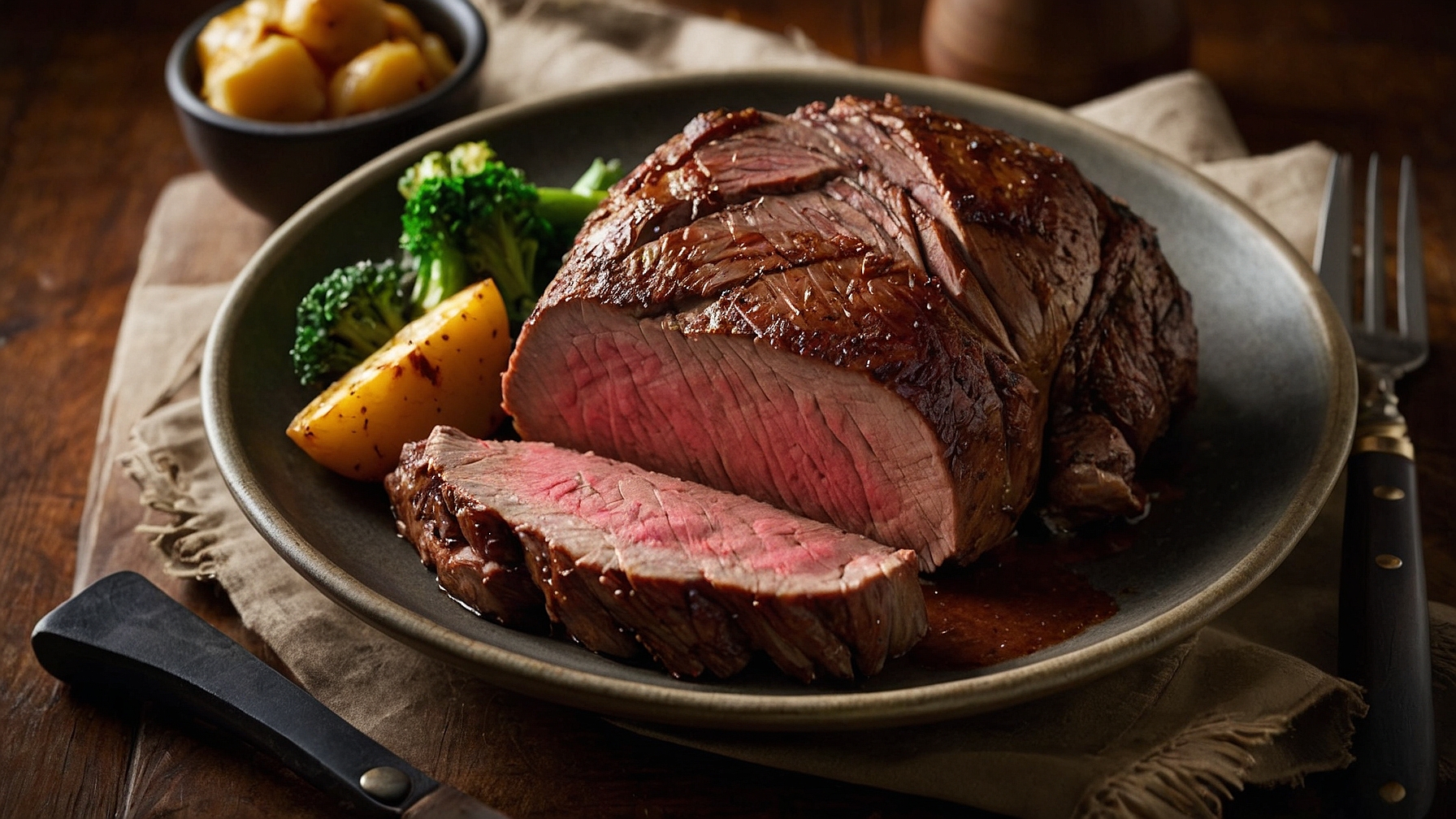
Prepare a tender, flavorful sirloin tip roast, cooked to your preferred doneness, perfect for any meal.
Ingredients
- 1 (1.35-1.8 kg) sirloin tip roast, trimmed
- 2 tbsp (30ml) olive oil
- 2 tsp (10g) kosher salt
- 1 tsp (5g) black pepper
- 1 tsp (5g) garlic powder
- 1 tsp (5g) onion powder
- 1 tbsp (5g) dried rosemary, crushed
- 1 tsp (2g) dried thyme
- 1 large (250g) yellow onion, quartered
- 2 large (250g) carrots, chopped into 2.5 cm pieces
- 2 (100g) celery stalks, chopped into 2.5 cm pieces
- 1 cup (240ml) low-sodium beef broth, or dry red wine
Instructions
- Preheat oven to `325°F (160°C)` for `20 minutes` with rack in middle position. Remove roast from refrigerator `30-60 minutes` before cooking to reach room temperature.
- Pat roast dry with paper towels to prepare for searing. Combine `2 tsp (10g) kosher salt, 1 tsp (5g) black pepper, 1 tsp (5g) garlic powder, 1 tsp (5g) onion powder, 1 tbsp (5g) dried rosemary, and 1 tsp (2g) dried thyme` in a small bowl.
- Drizzle `1 tbsp (15ml) olive oil` over roast, rub to coat. Sprinkle and press seasoning mixture evenly over all sides of roast.
- Heat a large, oven-safe skillet over `medium-high heat` for `3-4 minutes` until oil shimmers and just begins to smoke. Place roast in skillet. Sear all sides (top, bottom, 4 perimeter sides) for `2-3 minutes per side`, using tongs, until a dark brown crust forms, totaling `12-18 minutes`.
- Remove roast from skillet. Scatter `1 large (250g) quartered yellow onion, 2 large (250g) chopped carrots, and 2 (100g) chopped celery stalks` into the skillet. Pour `1 cup (240ml) low-sodium beef broth` (or red wine) into the pan around vegetables.
- Return roast to center of skillet, resting on vegetables. Insert oven-safe meat thermometer into thickest part of roast, avoiding bone or fat. Transfer skillet to preheated `325°F (160°C)` oven.
- Roast until target internal temperature. For a `1.35-1.8 kg` roast, estimated cook times are:
- `Rare`: Remove at `125-130°F (52-54°C)`, estimated `1 hour 15 minutes to 1 hour 45 minutes`.
- `Medium-Rare`: Remove at `130-135°F (54-57°C)`, estimated `1 hour 45 minutes to 2 hours 15 minutes`.
- `Medium`: Remove at `135-140°F (57-60°C)`, estimated `2 hours 15 minutes to 2 hours 45 minutes`.
Begin checking internal temperature `30 minutes before` estimated cook time. Remove roast `5-10°F (3-5°C)` below target final temperature; it will continue to cook while resting.
- Transfer roast from skillet to cutting board. Loosely tent roast with aluminum foil to retain warmth. Rest roast for `20-30 minutes`. Internal temperature will rise `5-10°F (3-5°C)` during rest.
- Remove foil after resting. Carve roast against grain into `6mm` thick slices. Arrange slices on platter and serve immediately, optionally with strained pan juices.
Notes
- Meat Thermometer: Use a reliable meat thermometer for accurate doneness. Visual cues are insufficient for roasts.
- Doneness Preference: Sirloin tip is a leaner cut. Cook to `medium-rare` or `medium` for optimal tenderness; overcooking results in dry, tough texture.
- Pan Sauce (Optional): For pan sauce: Remove roast and vegetables, pour off excess fat from skillet. Place skillet over `medium-high heat`. Deglaze with `1/2 cup (120ml)` red wine or beef broth, scraping up browned bits. Simmer `5-7 minutes`, stirring, until sauce slightly reduces and thickens. Strain through fine-mesh sieve and serve.
- Storage: Store leftover roast in airtight container in refrigerator for `3-4 days`. Cool completely before sealing.
- Reheating: Reheat individual slices in covered pan with `splash of beef broth` over `low heat` for `5-10 minutes` until warmed through. Avoid high heat or microwave to prevent drying.
Pro Tips for a Perfect Sirloin Tip Roast
Ingredient Tips
- Pre-salt for tenderness:Apply 1.5 tsp kosher salt per pound of roast 24-48 hours before cooking. This dry-brines, leading to a significantly juicier roast by retaining moisture.
- Marinate for flavor depth:Use 1/4 cup olive oil, 2 tbsp balsamic, 2 minced garlic, 1 tbsp dried rosemary, and 1 tsp black pepper. Marinate for 6-24 hours to deeply infuse flavor and tenderize.
- Choose the right size:Select a roast between 2.5 to 3.5 pounds for optimal consistency. Larger roasts overcook at ends; smaller cuts risk drying out faster.
Technique Tips
- Achieve even temperature:Remove roast from fridge 2 hours before cooking, allowing it to reach 65-70°F. This prevents uneven cooking, ensuring uniform doneness from edge to edge.
- High-heat sear:Preheat heavy-bottomed pan on medium-high for 5 minutes until shimmering. Sear 3-4 minutes per side until a deep, golden-brown crust forms, locking in juices and rich flavor.
- Precision roasting:Roast in a 325°F (160°C) oven until internal temperature reaches 120-125°F (49-52°C) for medium-rare. Use a meat thermometer; expect 18-22 minutes per pound.
- The essential rest:Transfer roast to a board, tent with foil, and rest 15-20 minutes. Internal temperature will rise 5-10°F; juices redistribute, ensuring a tender, moist slice.
- Slice against the grain:Identify muscle fibers and slice thinly (about 1/4-inch) perpendicular to the grain. This shortens fibers, making each bite tender, avoiding toughness.
- Deglaze for sauce:After searing, deglaze the hot pan with 1/2 cup beef broth or red wine. Scrape all browned bits (fond) with a wooden spoon for 2-3 minutes until bubbling at edges, forming a rich pan sauce.
Common Issues
- Dry, tough roast:If consistently dry, reduce oven temperature to 275°F (135°C) and cook for 25-30 minutes per pound, until 125°F (52°C) internal for medium-rare. This slow-roast method minimizes moisture loss.
- Lack of crust:Pat roast surface thoroughly dry before searing. Excess moisture prevents browning; sear each side for 4 minutes in a screaming hot pan (over 450°F / 230°C) until deep mahogany.
- Uneven cooking from ends to center:Tie the roast with butcher’s twine at 1-inch intervals. This compresses thinner sections, ensuring consistent thickness and even heat.
How to Store, Reheat, and Repurpose Sirloin Tip Roast
A beautifully cooked Sirloin Tip Roast is a centerpiece, but often there are leftovers. Knowing how to properly store and reheat this lean cut ensures you can enjoy its robust flavor for days to come, whether in its original glory or reimagined in new dishes. Proper handling is key to maintaining quality and food safety.
Refrigerator Storage
Duration: 3-4 days in airtight glass container
For optimal quality, allow your Sirloin Tip Roast to cool completely before transferring it to an airtight glass container. While plastic containers work, glass helps prevent any absorption of plastic flavors and odors. Store larger pieces whole or slice the roast into 1/4 to 1/2-inch thick pieces before refrigerating. Over time, the roast will naturally dry out slightly and the robust beef flavor may mellow, but it remains perfectly safe and delicious within the 3-4 day window. Beyond day 3, the texture can become noticeably firmer, making it ideal for shredding or dicing into other dishes.
Freezer Storage
Duration: 2-3 months
To freeze Sirloin Tip Roast, first ensure it is completely cool. Slice the roast into desired portions (individual servings are best for quick thawing) or leave it in larger chunks. Wrap each piece tightly in plastic wrap, pressing out as much air as possible, then wrap again securely in aluminum foil. Finally, place the foil-wrapped pieces into a heavy-duty freezer bag, labeling with the date. This double-wrapping method prevents freezer burn, which can lead to dry, discolored spots. To thaw, transfer the frozen roast to the refrigerator and allow 12-24 hours for smaller portions, or up to 24-48 hours for larger pieces. Expect a slight texture change upon thawing and reheating; the meat may become a bit tougher and drier than fresh, and its “fresh” beef aroma will be less pronounced.
Reheating Instructions
- Oven (Best Method):Preheat oven to 250°F. Place slices or whole pieces of roast in an oven-safe dish with 1-2 tablespoons of beef broth or water. Cover tightly with foil to create steam and prevent drying. Reheat for 15-25 minutes, or until the internal temperature reaches 130-140°F for medium-rare/medium. The edges should be warm and slightly yielding to the touch. This method keeps the meat moist and tender.
- Stovetop (Good for Slices):Slice the roast thinly. Heat a skillet over medium-low heat. Add a tablespoon of beef broth, water, or oil. Add the sliced roast and cover the skillet. Reheat for 3-5 minutes, flipping once, until warmed through. Be careful not to overcrowd the pan. This method is quick but can dry out the meat if overcooked.
- Microwave (Acceptable, use caution):Place individual slices or small portions in a microwave-safe dish with a splash of beef broth or water. Cover with a microwave-safe lid or damp paper towel. Reheat on 50% power for 1-2 minutes, checking and flipping every 30 seconds, until just warm. The microwave is convenient but tends to make the meat tougher and drier very quickly if not carefully monitored.
Make-Ahead Tips
Sirloin Tip Roast is an excellent candidate for make-ahead meals. You can cook the entire roast up to 3 days in advance. Once cooked and cooled, slice it into uniform pieces before refrigerating in an airtight glass container. This pre-slicing saves time and allows for quicker, more even reheating. Alternatively, consider preparing any accompanying sauces or side dishes (like mashed potatoes or roasted vegetables) 1-2 days in advance and storing them separately in their own airtight containers in the refrigerator. This streamlines the final meal assembly, allowing you to focus on gently reheating the star of the show.