
Vanilla French Beignets: Your Taste of New Orleans at Home
Master fluffy, airy Vanilla French Beignets in your own kitchen with this easy-to-follow recipe.
This recipe requires only 15 minutes of active preparation, yielding warm, pillowy treats ready for dusting.
These warm, vanilla-scented pastries are ideal for a decadent breakfast, a special brunch, or an elegant dessert, especially when paired with a hot beverage.
Vanilla French Beignets are square pieces of yeast-leavened dough, deep-fried until perfectly puffed and golden. This rendition infuses the dough with quality vanilla extract for a fragrant, sweet profile.
Careful dough proofing is crucial for their signature hollow, airy texture. Maintain the correct oil temperature during frying for a crispy exterior without over-browning. For optimal warmth and delicate crumb, serve immediately after frying, dusted generously with powdered sugar. This recipe provides clear instructions to guide you through each step, ensuring a successful batch of these classic French pastries.
Vanilla French Beignets
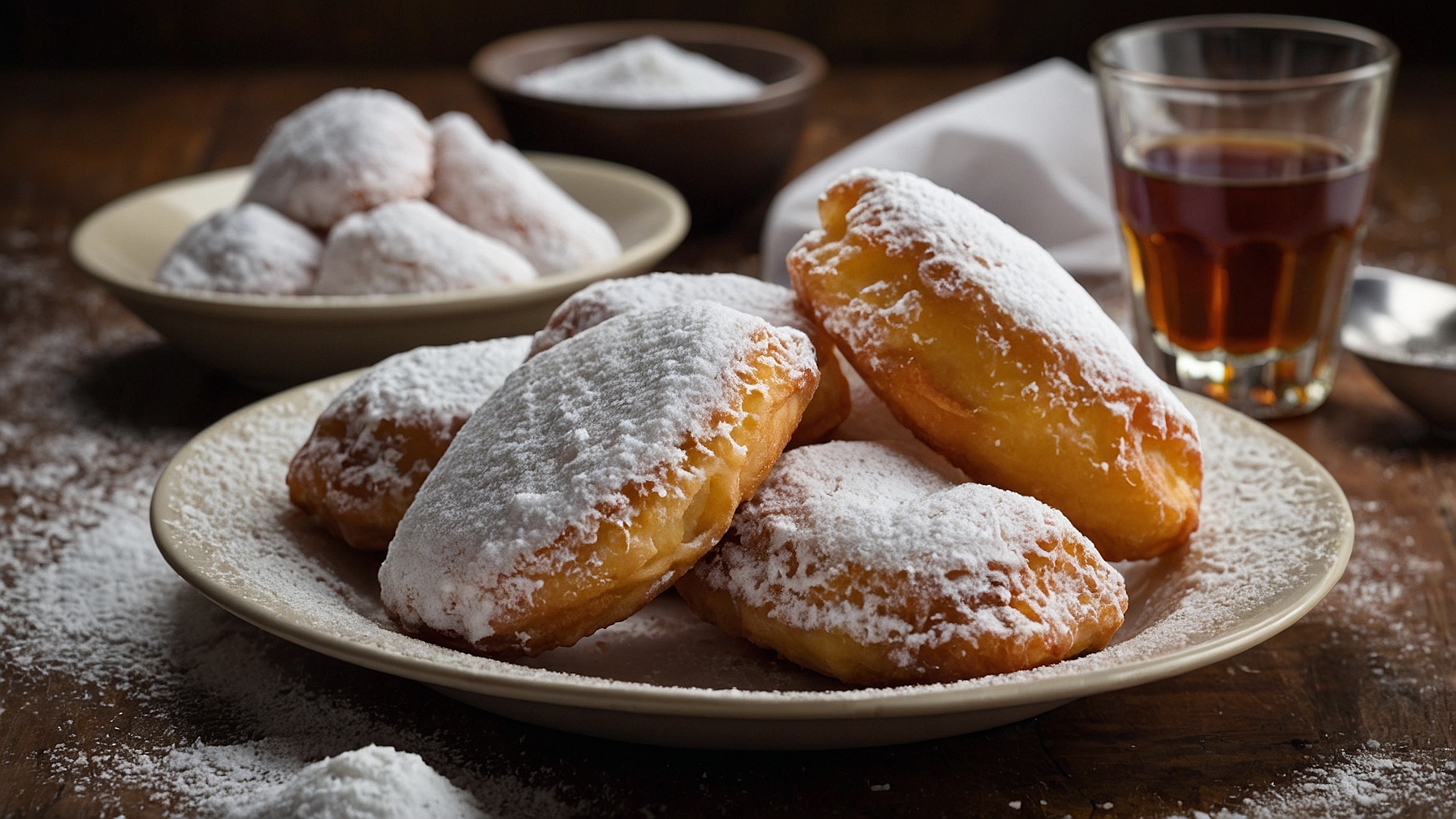
Vanilla French Beignets are fried dough pastries, featuring vanilla-infused dough, fried until golden brown, and dusted with powdered sugar.
Ingredients
- 1 cup (240ml) warm water, 105-115°F (40-46°C)
- 2 ¼ teaspoons (7g) active dry yeast
- ½ cup (100g) granulated sugar, divided
- 2 large eggs (100g), room temperature, lightly beaten
- 1 cup (240ml) evaporated milk
- 1 tablespoon (15ml) pure vanilla extract
- 6 to 6 ½ cups (720-780g) all-purpose flour, plus more for dusting
- 1 ½ teaspoons (9g) salt
- ½ cup (113g) unsalted butter, melted and cooled
- 6-8 cups (1.4-1.9 liters) vegetable oil, for deep frying
- 2 cups (240g) powdered sugar (confectioners’ sugar), for dusting
Instructions
- Combine 1 cup (240ml) warm water (105-115°F / 40-46°C), 1 tablespoon (12.5g) granulated sugar, and 2 ¼ teaspoons (7g) active dry yeast in a large bowl. Stir. Let stand 5-10 minutes until foamy.
- Add the remaining granulated sugar (7 tablespoons / 87.5g), 2 lightly beaten large eggs (100g), 1 cup (240ml) evaporated milk, and 1 tablespoon (15ml) pure vanilla extract to the yeast mixture. Whisk until combined and smooth.
- Whisk 6 cups (720g) all-purpose flour and 1 ½ teaspoons (9g) salt in a separate large bowl.
- Add the wet mixture to the dry ingredients. Mix with a wooden spoon or rubber spatula until a shaggy dough forms.
- Pour in ½ cup (113g) melted, cooled unsalted butter. Transfer dough to a floured surface. Knead 8-10 minutes, incorporating up to ½ cup (60g) additional flour, until dough is smooth and elastic.
- Place dough in an oiled large bowl; turn to coat. Cover with plastic wrap or a clean kitchen towel. Let rise in a warm place 1.5-2 hours, until doubled in size.
- Punch down the risen dough. Re-cover the bowl. Refrigerate 30 minutes to overnight.
- On a floured surface, roll dough to ¼ inch (6mm) thickness. Trim edges square with a knife or pizza cutter. Cut dough into 2-inch (5cm) squares.
- Arrange cut beignet squares on floured baking sheets, spacing apart. Cover with a clean kitchen towel. Let rise in a warm place 30-45 minutes, until puffed.
- Pour 6-8 cups (1.4-1.9 liters) vegetable oil, 3-4 inches (7.5-10cm) deep, into a large heavy-bottomed pot. Heat over medium-high heat to 350°F (175°C).
- Drop 4-5 beignet squares into the hot oil. Fry 1-2 minutes per side, turning once with tongs or a slotted spoon, until puffed and golden brown on both sides.
- Remove fried beignets with a slotted spoon. Transfer to a wire rack over a paper towel-lined baking sheet to drain. Repeat with remaining dough, ensuring oil returns to 350°F (175°C) between batches.
- While warm, dust beignets with 2 cups (240g) powdered sugar using a fine-mesh sieve. Serve immediately.
Notes
- Maintain oil temperature at 350°F (175°C). Cool oil results in greasy beignets; hot oil browns exterior too fast, leaving interior raw.
- Measure flour by weight (720-780g) or by spooning into a measuring cup and leveling. Do not scoop directly from the bag, as this adds too much flour and leads to dense beignets.
- Use pure vanilla extract. Imitation vanilla will not provide the same flavor depth.
- Serve beignets warm and fresh. They lose texture quickly upon cooling and do not store well.
Pro Tips for Perfect Vanilla French Beignets
Ingredient Tips
- Active Dry Yeast Activation:Combine 2 ¼ teaspoons (one standard packet) of active dry yeast with ½ cup of water heated to precisely 105-115°F (40-46°C) and 1 teaspoon of granulated sugar. Let it sit undisturbed for 5-10 minutes until the mixture is visibly foamy and bubbly, indicating the yeast is active and viable for leavening.
- Milk Temperature and Type:Warm 1 cup of whole milk to exactly 100-110°F (38-43°C) before incorporating it into the dough. Whole milk provides crucial richness and a tender crumb, ensuring your beignets are consistently light and airy, while the precise temperature helps activate the yeast without shocking it.
- Flour Measurement and Type:Precisely measure 3 ½ cups of unbleached all-purpose flour by spooning it into a measuring cup and leveling off with a straight edge, rather than scooping directly, to avoid compaction. Sift the flour through a fine-mesh sieve once or twice before adding to the wet ingredients to aerate it, preventing dense beignets and promoting a light, pillowy texture.
- Butter Incorporation:Use 4 tablespoons (½ stick) of unsalted butter, melted and cooled slightly to around 90°F (32°C). Incorporate it gradually into the dough towards the end of the initial mixing phase; this allows the gluten to develop sufficiently before the fat interferes, resulting in a more extensible and tender dough structure.
- High-Quality Vanilla Extract:Incorporate 2 teaspoons of pure vanilla extract, not imitation, after the primary mixing to preserve its delicate flavor. For an intensified aroma, split a vanilla bean lengthwise, scrape the seeds, and infuse them into the warm milk for 15 minutes before mixing, providing a deeper, more authentic vanilla essence.
Technique Tips
- Dough Kneading for Optimal Gluten:Knead the dough using a stand mixer with a dough hook on medium-low speed (setting 2-3) for a full 8-10 minutes, or 12-15 minutes by hand, until it becomes smooth, elastic, and slightly tacky. A well-developed dough will pass the “windowpane test” – a small piece stretches thin enough to see light through it without tearing – ensuring maximum puff and tenderness.
- Controlled First Rise:Place the kneaded dough in a lightly oiled bowl, turn to coat, cover with plastic wrap, and allow it to rise in a warm, draft-free spot (ideally 75-80°F / 24-27°C) for 1 ½ to 2 hours, or until it has visibly doubled in size. An adequate first rise is critical for developing flavor and achieving a light internal structure.
- Precise Dough Rolling and Cutting:Gently punch down the risen dough and roll it out on a lightly floured surface to a uniform thickness of exactly ¼ inch (0.6 cm). Cut the dough into consistent 2×2-inch (5×5 cm) squares or 2×3-inch (5×7.5 cm) rectangles. Uniformity ensures even cooking and consistent puffing across all beignets.
- Crucial Second Proof:Arrange the cut dough squares on a parchment-lined baking sheet, leaving at least 1 inch (2.5 cm) between them. Cover loosely with plastic wrap and let them proof at room temperature for an additional 15-20 minutes. This short second rise allows the gluten to relax and the yeast to produce a final burst of gas, resulting in maximum lift and airiness when fried.
- Optimal Frying Oil Temperature and Quantity:Heat 4-6 cups of neutral oil (such as canola, peanut, or vegetable oil) in a heavy-bottomed pot or Dutch oven to a precise 350-360°F (175-182°C). Use a deep-fry thermometer to monitor constantly. Dropping below 340°F (170°C) will result in greasy, dense beignets, while exceeding 370°F (188°C) will cause them to burn on the outside before cooking through, leaving a raw interior.
- Batch Frying and Turning:Fry 3-4 beignets at a time, ensuring not to overcrowd the pot, which drastically lowers the oil temperature. Fry for 1-2 minutes per side, using tongs to flip them when the bottom is a deep golden brown and visibly puffed. The entire frying process for each batch should take 2-4 minutes until they are evenly golden brown all over and feel light.
- Immediate Dusting:Once fried, immediately transfer the beignets to a cooling rack set over paper towels to drain excess oil for 30 seconds. While still warm, generously dust them with 1/2 to 3/4 cup of sifted powdered sugar through a fine-mesh sieve. The heat allows the sugar to adhere perfectly, creating that iconic snowy appearance and initial sweetness.
Common Issues
- Dense, Heavy Beignets:If your beignets are dense and lack puff, the issue is often under-proofing or insufficient kneading. Ensure the first rise allows the dough to truly double in size (1.5-2 hours at 75-80°F), and that the dough passes the windowpane test after kneading for 8-10 minutes. A second proof of 15-20 minutes for cut dough is also essential for final lightness.
- Greasy Beignets:Greasy beignets are almost always caused by too low oil temperature. Maintain your frying oil strictly between 350-360°F (175-182°C) with a thermometer. If the temperature drops below 340°F (170°C), the beignets absorb oil instead of cooking crisp. Also, avoid overcrowding the pot, as this instantly lowers the oil temperature by 20-30°F (7-11°C).
- Beignets Burned Outside, Raw Inside:This indicates the frying oil is too hot. If your oil exceeds 370°F (188°C), the exterior will brown and crisp too quickly, forming a barrier that prevents the heat from penetrating and cooking the interior. Reduce heat immediately and wait for the oil to drop back to the 350-360°F range before continuing to fry.
How to Store and Reheat Your Beignets
Vanilla French Beignets are undoubtedly best enjoyed fresh from the fryer, dusted generously with powdered sugar. However, if you find yourself with leftovers or wish to prepare ahead, proper storage and reheating can still yield a delightful treat. Be prepared for some minor texture changes as the fresh airiness is difficult to fully replicate.
Refrigerator Storage
Duration: 1-2 days in an airtight container
For optimal quality, consume beignets within 24 hours. Store cooled beignets in a single layer in an airtight glass container or a resealable plastic bag to prevent them from drying out or absorbing refrigerator odors. Over time, the beignets will lose their delicate crisp exterior and airy interior, becoming softer and chewier. The powdered sugar will also absorb moisture, clumping or disappearing entirely. While still edible, their fresh vanilla flavor and tender texture will decline significantly after the first day.
Freezer Storage
Duration: Up to 1 month
To freeze, arrange cooled beignets in a single layer on a baking sheet and flash freeze for 1-2 hours until solid. This prevents them from sticking together. Once frozen, transfer them to a heavy-duty freezer-safe bag or an airtight container, ensuring as much air as possible is removed to prevent freezer burn. When ready to enjoy, beignets can be reheated directly from frozen or thawed in the refrigerator overnight. Expect a slightly denser, chewier texture compared to fresh; the original light airiness is challenging to retain perfectly. Any powdered sugar will melt, so plan to re-dust them after reheating.
Reheating Instructions
- Oven/Toaster Oven (Recommended):Preheat to 325°F for 8-10 minutes. Place beignets on a wire rack set over a baking sheet to allow air circulation. Reheat until warm through and slightly puffed. This method works best for restoring some of their original crispness and provides the most satisfying texture.
- Air Fryer (Good Alternative):Preheat to 300°F for 3-5 minutes. Arrange beignets in a single layer in the air fryer basket. Cook until warm through with a slightly crisped exterior. This offers a quick and effective way to achieve a good texture.
- Microwave (Acceptable for Speed):Microwave on high power for 10-20 seconds per beignet. Place on a paper towel. Beignets will be warm to the touch but will become very soft, losing all crispness and potentially turning slightly doughy. While quick, this method is not recommended for optimal texture or flavor.
Always re-dust reheated beignets generously with fresh powdered sugar just before serving.
Make-Ahead Tips
For the freshest possible beignets, preparing the dough in advance is an excellent strategy. After the initial rise, gently punch down the Vanilla French Beignet dough, cover it tightly with plastic wrap to prevent a skin from forming, and refrigerate for up to 24-48 hours. When you’re ready to fry, simply remove the dough from the refrigerator, allow it to come to room temperature for about 30-60 minutes, then roll, cut into squares, perform the final short proofing, and fry as usual. Frying on demand ensures the light, airy texture and delicate flavor that makes beignets so special, rather than reheating previously fried ones. Remember to dust with powdered sugar only right before serving.